The federally recognized Round Valley Indian Tribes are a small, confederated people whose members today come from twelve indigenous California tribes. In 1849, during the California gold rush, people from several of these tribes were relocated to a reservation farm in northern Mendocino County. Fusing Native American history and labor history, William Bauer Jr. chronicles the evolution of work, community, and tribal identity among the Round Valley Indians in the nineteenth and twentieth centuries that enabled their survival and resistance to assimilation.
Drawing on oral history interviews, Bauer brings Round Valley Indian voices to the forefront in a narrative that traces their adaptations to shifting social and economic realities, first within unfree labor systems, including outright slavery and debt peonage, and later as wage laborers within the agricultural workforce. Despite the allotment of the reservation, federal land policies, and the Great Depression, Round Valley Indians innovatively used work and economic change to their advantage in order to survive and persist in the twentieth century. We Were All Like Migrant Workers Here relates their history for the first time.
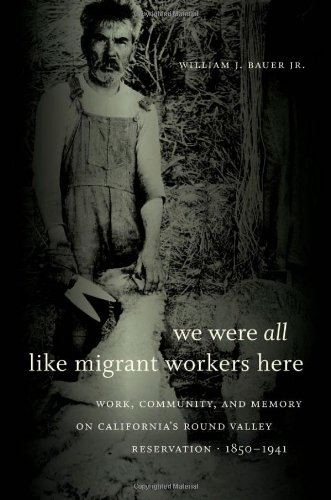
We Were All Like Migrant Workers Here: Work, Community, and Memory on California's Round Valley Reservation, 1850-1941
📄 Viewing lite version
Full site ›
Book Details
Author(s)William J. Jr. Bauer
ISBN / ASIN080783338X
ISBN-139780807833384
AvailabilityUsually ships in 24 hours
Sales Rank1,987,568
CategorySocial Science
MarketplaceUnited States 🇺🇸
Description ▲
More Books in Social Science
Introduction to the Sociology of Development
View
The Career Mystique: Cracks in the American Dream
View
Three Studies on Egyptian Feasts and their Chronologic…
View
American People Of Austrian Descent, including: Arnold…
View
World Wrestling Entertainment Championships, including…
View
Fetish Artists, including: John Willie, Robert Bishop …
View
Fictional Irish People, including: Leopold Bloom, Arte…
View
Sound Alliances: Indigenous Peoples, Cultural Politics…
View
Andean Entrepreneurs: Otavalo Merchants and Musicians …
View