Search Books

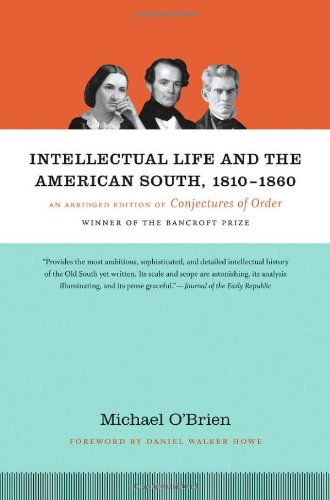
Intellectual Life and the American South, 1810-1860: An Abridged Edition of Conjectures of Order

Author Michael O'Brien
Publisher The University of North Carolina Press
📄 Viewing lite version Full site ›
🌎 Shop on Amazon — choose country
34.16 42.00 USD
🛒 Buy New on Amazon 🇺🇸 🏷 Buy Used — $24.97

✓ Usually ships in 24 hours

Share:
Book Details
ISBN / ASIN0807834009
ISBN-139780807834008
AvailabilityUsually ships in 24 hours
Sales Rank2,101,944
MarketplaceUnited States 🇺🇸

Description

Michael O’Brien has masterfully abridged his award-winning two-volume intellectual history of the Old South, Conjectures of Order, depicting a culture that was simultaneously national, postcolonial, and imperial, influenced by European intellectual traditions, yet also deeply implicated in the making of the American mind.

Here O’Brien succinctly and fluidly surveys the lives and works of many significant Southern intellectuals, including John C. Calhoun, Louisa McCord, James Henley Thornwell, and George Fitzhugh. Looking over the period, O'Brien identifies a movement from Enlightenment ideas of order to a Romanticism concerned with the ambivalences of personal and social identity, and finally, by the 1850s, to an early realist sensibility. He offers a new understanding of the South by describing a place neither monolithic nor out of touch, but conflicted, mobile, and ambitious to integrate modern intellectual developments into its tense and idiosyncratic social experience.
Michael O’Brien has masterfully abridged his award-winning two-volume intellectual history of the Old South, Conjectures of Order, depicting a culture that was simultaneously national, postcolonial, and imperial, influenced by European intellectual traditions, yet also deeply implicated in the making of the American mind.

Here O’Brien succinctly and fluidly surveys the lives and works of many significant Southern intellectuals, including John C. Calhoun, Louisa McCord, James Henley Thornwell, and George Fitzhugh. Looking over the period, O'Brien identifies a movement from Enlightenment ideas of order to a Romanticism concerned with the ambivalences of personal and social identity, and finally, by the 1850s, to an early realist sensibility. He offers a new understanding of the South by describing a place neither monolithic nor out of touch, but conflicted, mobile, and ambitious to integrate modern intellectual developments into its tense and idiosyncratic social experience.