As its interests have become deeply tied to the Middle East, the United States has long sought to develop a usable understanding of the people, politics, and cultures of the region. In Imagining the Middle East, Matthew Jacobs illuminates how Americans' ideas and perspectives about the region have shaped, justified, and sustained U.S. cultural, economic, military, and political involvement there.
Jacobs examines the ways in which an informal network of academic, business, government, and media specialists interpreted and shared their perceptions of the Middle East from the end of World War I through the late 1960s. During that period, Jacobs argues, members of this network imagined the Middle East as a region defined by certain common characteristics--religion, mass politics, underdevelopment, and an escalating Arab-Israeli-Palestinian conflict--and as a place that might be transformed through U.S. involvement. Thus, the ways in which specialists and policymakers imagined the Middle East of the past or present came to justify policies designed to create an imagined Middle East of the future. Jacobs demonstrates that an analysis of the intellectual roots of current politics and foreign policy is critical to comprehending the styles of U.S. engagement with the Middle East in a post-9/11 world.
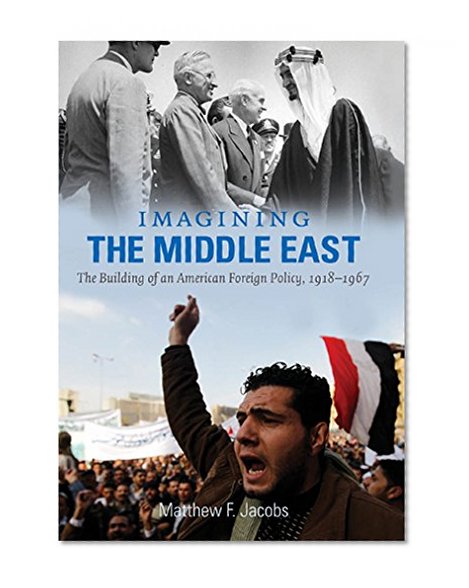
Imagining the Middle East: The Building of an American Foreign Policy, 1918-1967
📄 Viewing lite version
Full site ›
Book Details
Author(s)Matthew F. Jacobs
ISBN / ASIN0807834882
ISBN-139780807834886
AvailabilityUsually ships in 24 hours
Sales Rank93,791
CategoryHistory
MarketplaceUnited States 🇺🇸
Description ▲
More Books in History
The Bet, and Other Stories
View
Pakistan and the Bomb: Public Opinion and Nuclear Opti…
View
Writing National Histories: Western Europe Since 1800
View
Empire in Eclipse
View
Monks and Laymen in Byzantium, 843-1118
View
The Wilmington and Western Railroad (Images of Rail: D…
View
Black Sailor, White Navy: Racial Unrest in the Fleet d…
View
Feasibility of Laser Power Transmission to a High-Alti…
View
The Democratic Republic: 1801-1815
View
The Majesty of Egyptian Gods and Temples: A Book of Eg…
View