Search Books
Labor and Desire: Women's R… Reading the Romance: Women,…

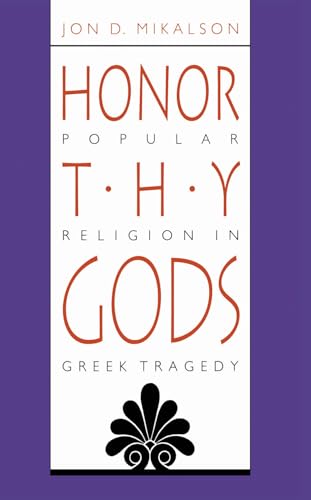
Honor Thy Gods: Popular Religion in Greek Tragedy

Author Jon D. Mikalson
Publisher The University of North Carolina Press
Category Literary Criticism
📄 Viewing lite version Full site ›
🌎 Shop on Amazon — choose country
32.22 39.95 USD
🛒 Buy New on Amazon 🇺🇸 🏷 Buy Used — $6.85

✓ In stock. Usually ships within 2 to 3 days.

Share:
Book Details
ISBN / ASIN0807843482
ISBN-139780807843482
AvailabilityIn stock. Usually ships within 2 to 3 days.
Sales Rank2,734,250
MarketplaceUnited States 🇺🇸

Description

In Honor Thy Gods Jon Mikalson uses the tragedies of Aeschylus, Sophocles, and Euripides to explore popular religious beliefs and practices of Athenians in the fifth and fourth centuries B.C. and examines how these playwrights portrayed, manipulated, and otherwise represented popular religion in their plays. He discusses the central role of honor in ancient Athenian piety and shows that the values of popular piety are not only reflected but also reaffirmed in tragedies.

Mikalson begins by examining what tragic characters and choruses have to say about the nature of the gods and their intervention in human affairs. Then, by tracing the fortunes of diverse characters -- among them Creon and Antigone, Ajax and Odysseus, Hippolytus, Pentheus, and even Athens and Troy -- he shows that in tragedy those who violate or challenge contemporary popular religious beliefs suffer, while those who support these beliefs are rewarded.

The beliefs considered in Mikalson's analysis include Athenians' views on matters regarding asylum, the roles of guests and hosts, oaths, the various forms of divination, health and healing, sacrifice, pollution, the religious responsibilities of parents, children, and citizens, homicide, the dead, and the afterlife. After summarizing the vairous forms of piety and impiety related to these beliefs found in the tragedies, Mikalson isolates "honoring the gods" as the fundamental concept of Greek piety. He concludes by describing the different relationships of the three tragedians to the religion of their time and their audience, arguing that the tragedies of Euripides most consistently support the values of popular religion.

Writing Sri Lanka: Literature, Resistance & the Politi…
View
People Get Ready: African American and Caribbean Cultu…
View
Adelard of Bath Conversatns Nephew (Cambridge Medieval…
View
Graphic Novels: A Bibliographic Guide to Book-Length C…
View
Stephen King A Face Among The Masters
View
Rerouting the Postcolonial
View
Lunar Voices: Of Tragedy, Poetry, Fiction, and Thought
View
The Limits of Critique
View