In this outstanding book Susan Strehle argues that a new fiction has developed from the influence of modern physics. She calls this new fiction actualism, and within that framework she offers a critical analysis of major novels by Thomas Pynchon, Robert Coover, William Gaddis, John Barth, Margaret Atwood, and Donald Barthelme.
According to Strehle, the actualists balance attention to questions of art with an engaged meditation on the external, actual world. While these actualist novels diverge markedly from realistic practice, Strehle claims that they do so in order to reflect more acutely what we now understand as real. Reality is no longer "realistic"; in the new physical or quantum universe, reality is discontinuous, energetic, relative, statistical, subjectively seen, and uncertainly known -- all terms taken from new physics.
Actualist fiction is characterized by incompletions, indeterminacy, and "open" endings unsatisfying to the readerly wish for fulfilled promises and completed patterns. Gravity's Rainbow, for example, ends not with a period but with a dash. Strehle argues that such innovations in narrative reflect on twentieth-century history, politics, science, and discourse.
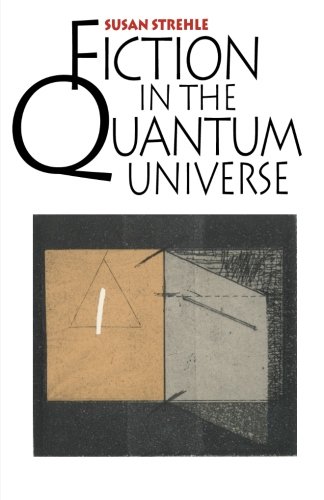
Fiction in the Quantum Universe
📄 Viewing lite version
Full site ›
Book Details
Author(s)Susan Strehle
ISBN / ASIN0807843652
ISBN-139780807843659
AvailabilityUsually ships in 24 hours
Sales Rank2,733,002
CategoryLiterary Criticism
MarketplaceUnited States 🇺🇸
Description ▲
More Books in Literary Criticism
Borges and the Politics of Form (Latin American Studie…
View
CliffsNotes on Achebe's Things Fall Apart (Dummies Tra…
View
The Acoustic World of Early Modern England: Attending …
View
The Land's Wild Music: Encounters with Barry Lopez, Pe…
View
Chemical Oscillations and Instabilities: Non-linear Ch…
View
Il romanzo al passato: Medioevo e invenzione in tre au…
View
Ghazali and the Poetics of Imagination (Islamic Civili…
View
History of My Life, Vols. 7 & 8
View