The American revolutionaries themselves believed the change from monarchy to republic was the essence of the Revolution. King and People in Provincial Massachusetts explores what monarchy meant to Massachusetts under its second charter and why the momentous change to republican government came about.
Richard L. Bushman argues that monarchy entailed more than having a king as head of state: it was an elaborate political culture with implications for social organization as well. Massachusetts, moreover, was entirely loyal to the king and thoroughly imbued with that culture.
Why then did the colonies become republican in 1776? The change cannot be attributed to a single thinker such as John Locke or to a strain of political thought such as English country party rhetoric. Instead, it was the result of tensions ingrained in the colonial political system that surfaced with the invasion of parliamentary power into colonial affairs after 1763.
The underlying weakness of monarchical government in Massachusetts was the absence of monarchical society -- the intricate web of patronage and dependence that existed in England. But the conflict came from the colonists' conception of rulers as an alien class of exploiters whose interest was the plundering of the colonies. In large part, colonial politics was the effort to restrain official avarice.
The author explicates the meaning of "interest" in political discourse to show how that conception was central in the thinking of both the popular party and the British ministry. Management of the interest of royal officials was a problem that continually bedeviled both the colonists and the crown. Conflict was perennial because the colonists and the ministry pursued diverging objectives in regulating colonial officialdom. Ultimately the colonists came to see that safety against exploitation by self-interested rulers would be assured only by republican government.
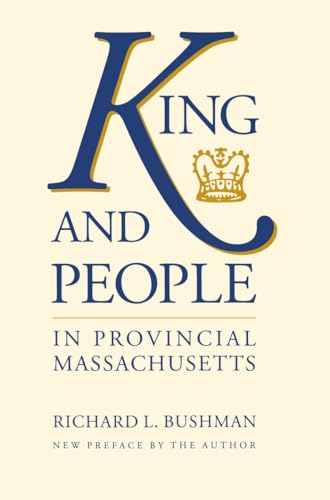
King and People in Provincial Massachusetts (Published for the Omohundro Institute of Early American History and Culture, Williamsburg, Virginia)
📄 Viewing lite version
Full site ›
Book Details
Author(s)Richard L. Bushman
ISBN / ASIN0807843989
ISBN-139780807843987
AvailabilityUsually ships in 24 hours
Sales Rank1,192,995
CategoryHistory
MarketplaceUnited States 🇺🇸
Description ▲
More Books in History
The Bet, and Other Stories
View
Pakistan and the Bomb: Public Opinion and Nuclear Opti…
View
Writing National Histories: Western Europe Since 1800
View
Empire in Eclipse
View
Monks and Laymen in Byzantium, 843-1118
View
The Wilmington and Western Railroad (Images of Rail: D…
View
Black Sailor, White Navy: Racial Unrest in the Fleet d…
View
Feasibility of Laser Power Transmission to a High-Alti…
View
The Democratic Republic: 1801-1815
View