More than sixty million people have been victims of genocide in the twentieth century alone, including recent casualties in Bosnia and Rwanda. Herbert Hirsch studies repetitions of large-scale human violence in order to ascertain why people in every historical epoch seem so willing to kill each other. He argues that the primal passions unleashed in the cause of genocide are tied to the manipulation of memory for political purposes. According to Hirsch, leaders often invoke or create memories of real or fictitious past injustices to motivate their followers to kill for political gain or other reasons. Generations pass on their particular versions of events, which then become history. If we understand how cultural memory is created, Hirsch says, we may then begin to understand how and why episodes of mass murder occur and will be able to act to prevent them. In order to revise the politics of memory, Hirsch proposes essential reforms in both the modern political state and in systems of education.
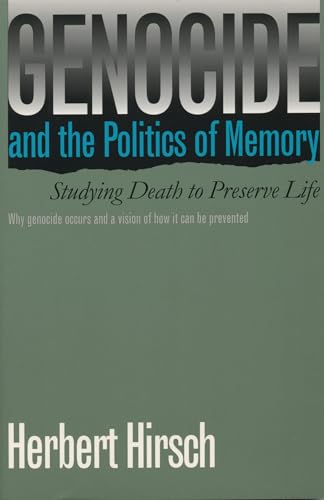
Genocide and the Politics of Memory: Studying Death to Preserve Life
📄 Viewing lite version
Full site ›
Book Details
Author(s)Herbert Hirsch
ISBN / ASIN0807845051
ISBN-139780807845059
AvailabilityUsually ships in 24 hours
Sales Rank2,264,790
CategorySocial Science
MarketplaceUnited States 🇺🇸
Description ▲
More Books in Social Science
Introduction to the Sociology of Development
View
The Career Mystique: Cracks in the American Dream
View
Three Studies on Egyptian Feasts and their Chronologic…
View
American People Of Austrian Descent, including: Arnold…
View
World Wrestling Entertainment Championships, including…
View
Fetish Artists, including: John Willie, Robert Bishop …
View
Fictional Irish People, including: Leopold Bloom, Arte…
View
Sound Alliances: Indigenous Peoples, Cultural Politics…
View
Andean Entrepreneurs: Otavalo Merchants and Musicians …
View