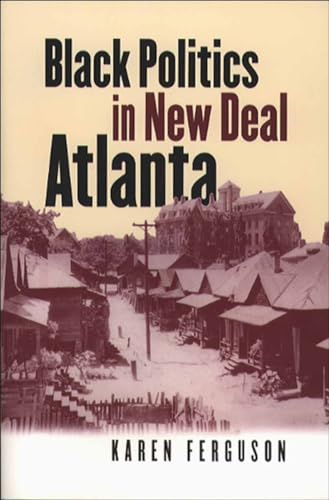
When Franklin Roosevelt was elected president in 1932, Atlanta had the South's largest population of college-educated African Americans. The dictates of Jim Crow meant that these men and women were almost entirely excluded from public life, but as Karen Ferguson demonstrates, Roosevelt's New Deal opened unprecedented opportunities for black Atlantans struggling to achieve full citizenship.
Black reformers, often working within federal agencies as social workers and administrators, saw the inclusion of African Americans in New Deal social welfare programs as a chance to prepare black Atlantans to take their rightful place in the political and social mainstream. They also worked to build a constituency they could mobilize for civil rights, in the process facilitating a shift from elite reform to the mass mobilization that marked the postwar black freedom struggle.
Although these reformers' efforts were an essential prelude to civil rights activism, Ferguson argues that they also had lasting negative repercussions, embedded as they were in the politics of respectability. By attempting to impose bourgeois behavioral standards on the black community, elite reformers stratified it into those they determined deserving to participate in federal social welfare programs and those they consigned to remain at the margins of civic life.
Black Politics in New Deal Atlanta (The John Hope Franklin Series in African American History and Culture)
📄 Viewing lite version
Full site ›
Book Details
Author(s)Karen Ferguson
ISBN / ASIN0807853704
ISBN-139780807853702
AvailabilityUsually ships in 24 hours
Sales Rank2,579,942
CategorySocial Science
MarketplaceUnited States 🇺🇸
Description ▲
More Books in Social Science
Daughters Of Tunis: Women, Family, And Networks In A M…
View
The Colonial Harem
View
Bisexuality and the Eroticism of Everyday Life
View
Elementary Statistics in Social Research (8th Edition)
View
Cannibals and Kings: Origins of Cultures
View
Mothering from the Inside: Parenting in a Women's Pris…
View
The Lakota Way: Stories and Lessons for Living (Compas…
View
Women in Control?: The Role of Women in Law Enforcemen…
View