Search Books
Sex among the Rabble: An In… The Shenandoah Valley Campa…

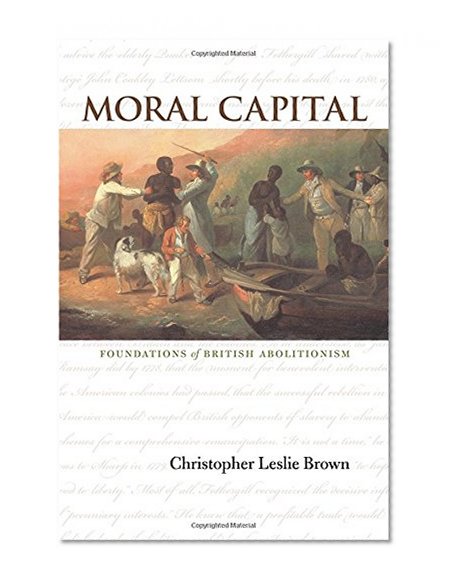
Moral Capital: Foundations of British Abolitionism (Published for the Omohundro Institute of Early American History and Culture)

Author Christopher Leslie Brown
Publisher The University of North Carolina Press
Category History
📄 Viewing lite version Full site ›
🌎 Shop on Amazon — choose country
26.59 30.00 USD
🛒 Buy New on Amazon 🇺🇸 🏷 Buy Used — $13.00

✓ Usually ships in 24 hours

Share:
Book Details
ISBN / ASIN0807856983
ISBN-139780807856987
AvailabilityUsually ships in 24 hours
Sales Rank651,509
CategoryHistory
MarketplaceUnited States 🇺🇸

Description

Revisiting the origins of the British antislavery movement of the late eighteenth century, Christopher Leslie Brown challenges prevailing scholarly arguments that locate the roots of abolitionism in economic determinism or bourgeois humanitarianism. Brown instead connects the shift from sentiment to action to changing views of empire and nation in Britain at the time, particularly the anxieties and dislocations spurred by the American Revolution.

The debate over the political rights of the North American colonies pushed slavery to the fore, Brown argues, giving antislavery organizing the moral legitimacy in Britain it had never had before. The first emancipation schemes were dependent on efforts to strengthen the role of the imperial state in an era of weakening overseas authority. By looking at the initial public contest over slavery, Brown connects disparate strands of the British Atlantic world and brings into focus shifting developments in British identity, attitudes toward Africa, definitions of imperial mission, the rise of Anglican evangelicalism, and Quaker activism.

Demonstrating how challenges to the slave system could serve as a mark of virtue rather than evidence of eccentricity, Brown shows that the abolitionist movement derived its power from a profound yearning for moral worth in the aftermath of defeat and American independence. Thus abolitionism proved to be a cause for the abolitionists themselves as much as for enslaved Africans.

The Studs Terkel Reader: My American Century
View
To Conquer Hell: The Meuse-Argonne, 1918 The Epic Batt…
View
Black Spokane: The Civil Rights Struggle in the Inland…
View
Killers of the King: The Men Who Dared to Execute Char…
View
Russia: A History
View
M3 Medium Tank vs Panzer III: Kasserine Pass 1943 (Due…
View
The Annals of Imperial Rome (Penguin Classics)
View
Leon Trotsky on France
View