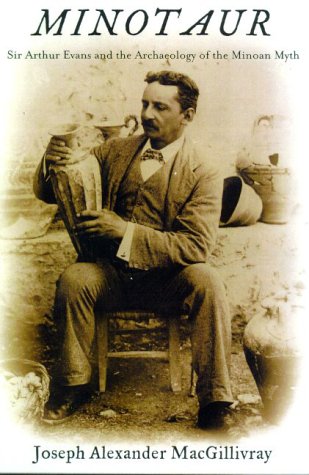
Minotaur: Sir Arthur Evans and the Archaeology of the Minoan Myth
📄 Viewing lite version
Full site ›
Book Details
PublisherHill & Wang
ISBN / ASIN0809030357
ISBN-139780809030354
Sales Rank1,216,751
MarketplaceUnited States 🇺🇸
Description ▲
Arthur Evans leapt into the public imagination with his 1900 discovery of Crete's Palace of Knossos, interpreted as the lair of the mythical Minotaur. Though his findings were a crowning achievement of archaeology's golden age, then, as now, questions have been raised about Evans's excavations and the conclusions he reached. In the richly detailed Minotaur, Joseph Alexander MacGillivray, who has himself excavated Crete, suggests that the man who gave us the very term Minoan provides a prime example of "how archaeological discovery occurs first in the mind." By examining Evans's life and work through his actions and correspondence, MacGillivray shows that Evans's evidence was "fully, even exaggeratedly exploited" but rarely reviewed. Adventurous, energetic, and highly observant, Evans also displayed "single-minded arrogance," "pomposity and manifest racism"--traits that invited misinterpretation, MacGillivray writes. The book also incorporates an interesting history of war-torn Crete and the Balkans as well as Evans's involvement in the region's politics. It finally outlines modern theories on Minoan civilization, though the "Palace and surrounding buildings are crumbling as fast as Evans's intellectual reconstruction," so that solid proof of any thesis is increasingly problematic. Fascinating as a portrait of the man who "gave the world a new chapter in its ancient history" and for its portrayal of the developing discipline of archaeology, Minotaur also poses some important questions about whether archaeologists are ever impartial observers. --Karen Tiley