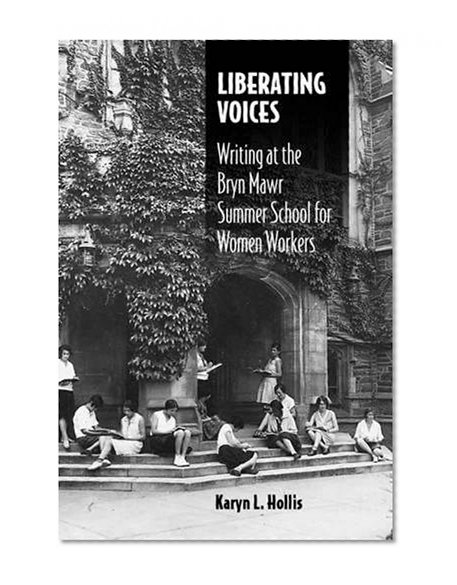
During the 1920s and 1930s at the Bryn Mawr Summer School for Women Workers, working-class women were educated in the liberal arts and instructed in writing to assume more powerful roles in the industrial workplace. In Liberating Voices: Writing at the Bryn Mawr Summer School for Women Workers, Karyn L. Hollis tells the remarkable story of how this multiclass, multiethnic American institution rooted in composition pedagogy, literary history, and leftist thought emerged from the broad social, economic, and ideological trends of the era. The summer school curriculum, Hollis shows, enhanced the individual and collective self-confidence of the 1,800 women who studied there between 1921 and 1938.
Â
Drawing heavily on the women’s writings—including autobiography, poetry, labor drama, humor, and economic reporting—Liberating Voices adds significantly to the small oeuvre of published writing by working-class women, who were, in this case, mostly nontraditional students, immigrants, and minorities. Outlining a materialist pedagogy that centers on the women’s daily economic struggles as well as their family and community experiences, Hollis reveals the tensions that stemmed from differences in race, ethnicity, class, and religion. She also shows how the students exploited cultural scripts and drew strength from their diversity, eventually insisting on a democratic sharing of power with faculty and administrators at the Summer School.
           Â
Hollis provides a thorough ethnography of the Summer School with respect to its place in the social and political history of the 1920s and 1930s, and then situates the school’s pedagogy within the history of American education and composition instruction. Concepts from literary criticism and composition theory provide the framework for an analysis of the working women’s autobiographical writing, revealing how the narrative voice of their prose grew from weak and individualized to empowered and collective as the women described their families, childhood, work, unions, and education over time. The volume is complemented by sixteen illustrations.
Â
Additional analysis of the women’s poetry points to their skill as both producers and consumers of literature. The common theme of body versus a powerful machine in the workplace bears witness to the industrial exploitation the women endured. Taking up postmodern questions of agency and voice, Hollis argues that the women used a variety of cultural texts to construct discourses that reflected their needs and desires. Liberating Voices not only provides a previously untold chapter in the history of American worker education, it also showcases a liberating pedagogy that has salient implications for contemporary classrooms.