In the tradition of The Power of Habit and Thinking, Fast and Slow comes a practical, playful, and endlessly fascinating guide to what we really know about learning and memory today—and how we can apply it to our own lives.
From an early age, it is drilled into our heads: Restlessness, distraction, and ignorance are the enemies of success. We’re told that learning is all self-discipline, that we must confine ourselves to designated study areas, turn off the music, and maintain a strict ritual if we want to ace that test, memorize that presentation, or nail that piano recital.
But what if almost everything we were told about learning is wrong? And what if there was a way to achieve more with less effort?
In How We Learn, award-winning science reporter Benedict Carey sifts through decades of education research and landmark studies to uncover the truth about how our brains absorb and retain information. What he discovers is that, from the moment we are born, we are all learning quickly, efficiently, and automatically; but in our zeal to systematize the process we have ignored valuable, naturally enjoyable learning tools like forgetting, sleeping, and daydreaming. Is a dedicated desk in a quiet room really the best way to study? Can altering your routine improve your recall? Are there times when distraction is good? Is repetition necessary? Carey’s search for answers to these questions yields a wealth of strategies that make learning more a part of our everyday lives—and less of a chore.
By road testing many of the counterintuitive techniques described in this book, Carey shows how we can flex the neural muscles that make deep learning possible. Along the way he reveals why teachers should give final exams on the first day of class, why it’s wise to interleave subjects and concepts when learning any new skill, and when it’s smarter to stay up late prepping for that presentation than to rise early for one last cram session. And if this requires some suspension of disbelief, that’s because the research defies what we’ve been told, throughout our lives, about how best to learn.
The brain is not like a muscle, at least not in any straightforward sense. It is something else altogether, sensitive to mood, to timing, to circadian rhythms, as well as to location and environment. It doesn’t take orders well, to put it mildly. If the brain is a learning machine, then it is an eccentric one. In How We Learn, Benedict Carey shows us how to exploit its quirks to our advantage.
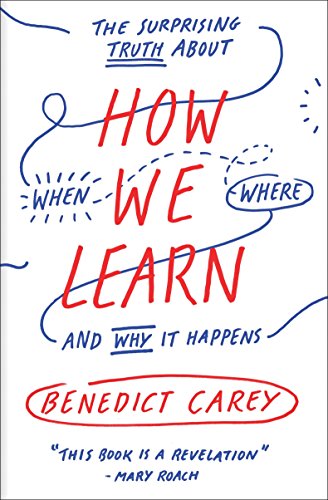
How We Learn: The Surprising Truth About When, Where, and Why It Happens
📄 Viewing lite version
Full site ›
Book Details
Author(s)Carey, Benedict
PublisherRandom House Trade Paperbacks
ISBN / ASIN0812984293
ISBN-139780812984293
AvailabilityIn Stock.
Sales Rank25,096
CategoryPsychology
MarketplaceUnited States 🇺🇸
Description ▲
Similar Products ▼
- Make It Stick: The Science of Successful Learning
- Design for How People Learn (2nd Edition) (Voices That Matter)
- Small Teaching: Everyday Lessons from the Science of Learning
- Understanding How We Learn: A Visual Guide
- How Learning Works: Seven Research-Based Principles for Smart Teaching
- A Mind for Numbers: How to Excel at Math and Science (Even If You Flunked Algebra)
- The Art and Science of Training
- The Accidental Instructional Designer: Learning Design for the Digital Age
- Why Don't Students Like School?: A Cognitive Scientist Answers Questions About How the Mind Works and What It Means for the Classroom
- Teach Students How to Learn: Strategies You Can Incorporate Into Any Course to Improve Student Metacognition, Study Skills, and Motivation
More Books in Psychology
Creative Therapy: Activities with Children and Adolesc…
View
Therapy in the Real World: Effective Treatments for Ch…
View
Cognition: Theory and Practice
View
Give Back the Pain: Emotional Healing through Source C…
View
Mindfulness and Schema Therapy: A Practical Guide
View
Supervision as Collaboration in the Human Services: Bu…
View
Genes and Behavior: Nature-Nurture Interplay Explained
View
Antisocial Behavior
View