America is becoming a class-based society.
It is now conventional wisdom to focus on the wealth of the top 1 percent—especially the top 0.01 percent—and how the ultra-rich are concentrating income and prosperity while incomes for most other Americans are stagnant. But the most important, consequential, and widening gap in American society is between the upper middle class and everyone else.
Reeves defines the upper middle class as those whose incomes are in the top 20 percent of American society. Income is not the only way to measure a society, but in a market economy it is crucial because access to money generally determines who gets the best quality education, housing, health care, and other necessary goods and services.
As Reeves shows, the growing separation between the upper middle class and everyone else can be seen in family structure, neighborhoods, attitudes, and lifestyle. Those at the top of the income ladder are becoming more effective at passing on their status to their children, reducing overall social mobility. The result is not just an economic divide but a fracturing of American society along class lines. Upper-middle-class children become upper-middle-class adults.
These trends matter because the separation and perpetuation of the upper middle class corrode prospects for more progressive approaches to policy. Various forms of “opportunity hoarding” among the upper middle class make it harder for others to rise up to the top rung. Examples include zoning laws and schooling, occupational licensing, college application procedures, and the allocation of internships. Upper-middle-class opportunity hoarding, Reeves argues, results in a less competitive economy as well as a less open society.
Inequality is inevitable and can even be good, within limits. But Reeves argues that society can take effective action to reduce opportunity hoarding and thus promote broader opportunity. This fascinating book shows how American society has become the very class-defined society that earlier Americans rebelled against—and what can be done to restore a more equitable society.
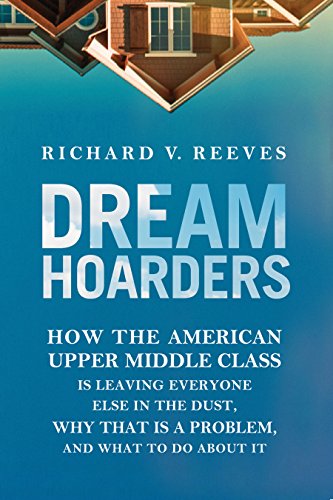
Dream Hoarders: How the American Upper Middle Class Is Leaving Everyone Else in the Dust, Why That Is a Problem, and What to Do About It
📄 Viewing lite version
Full site ›
Book Details
Author(s)Reeves, Richard V.
PublisherBrookings Institution Press
ISBN / ASIN081572912X
ISBN-139780815729129
AvailabilityIn Stock.
Sales Rank41,264
CategoryBusiness & Economics
MarketplaceUnited States 🇺🇸
Description ▲
Similar Products ▼
- The Sum of Small Things: A Theory of the Aspirational Class
- Toxic Inequality: How America's Wealth Gap Destroys Mobility, Deepens the Racial Divide, and Threatens Our Future
- Making Sense of the Alt-Right
- I Can't Breathe: A Killing on Bay Street
- Uneasy Street: The Anxieties of Affluence
- The Populist Explosion: How the Great Recession Transformed American and European Politics
- Our Kids: The American Dream in Crisis
- Success and Luck: Good Fortune and the Myth of Meritocracy
- Making Ends Meet: How Single Mothers Survive Welfare and Low-Wage Work (European Studies)
- Unequal Childhoods: Class, Race, and Family Life, 2nd Edition with an Update a Decade Later
More Books in Business & Economics
Business Cycles and Forecasting
View
Development Economics: Its Position in the Present Sta…
View
Cost Systems Design
View
So You Want to Dance on Broadway
View
The Blueprint: Reviving Innovation, Rediscovering Risk…
View
Managing IT Outsourcing, Second Edition
View
Education and the Creation of Capital in the Early Ame…
View
Global Corruption Report 2005: Special Focus: Corrupti…
View
More Tales for Trainers: Using Stories and Metaphors t…
View