Search Books
The Nation's Region: Southe… Wilderness into Civilized S…

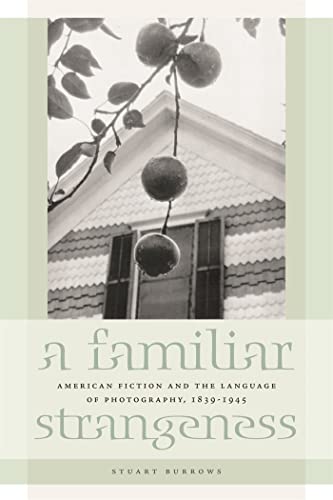
A Familiar Strangeness: American Fiction and the Language of Photography, 1839-1945

Author Stuart Burrows
Publisher University of Georgia Press
Category Literary Criticism
📄 Viewing lite version Full site ›
🌎 Shop on Amazon — choose country
22.46 24.95 USD
🛒 Buy New on Amazon 🇺🇸 🏷 Buy Used — $18.46

✓ Usually ships in 24 hours

Share:
Book Details
ISBN / ASIN0820335215
ISBN-139780820335216
AvailabilityUsually ships in 24 hours
Sales Rank2,971,066
MarketplaceUnited States 🇺🇸

Description

Literary critics have traditionally suggested that the invention of photography led to the rise of the realist novel, which is believed to imitate the detail and accuracy of the photographic image. Instead, says Stuart Burrows, photography's influence on American fiction had less to do with any formal similarity between the two media than with the capacity of photography to render American identity and history homogeneous and reproducible. The camera, according to Burrows, provoked a representational crisis, one broadly modernist in character. Since the photograph is not only a copy of its subject but a physical product of it, the camera can be seen as actually challenging mimetic or realistic theories of representation, which depend on a recognizable gap between original and reproduction.

Burrows argues for the centrality of photography to a set of writers commonly thought of as hostile to the camera-including Nathaniel Hawthorne, Henry James, William Faulkner, and Zora Neale Hurston. The photographic metaphors and allusions to the medium that appear throughout these writers' work demonstrate the ways in which one representational form actually influences another—by changing how artists conceive of identity, history, and art itself.

A Familiar Strangeness thus challenges the notion of an absolute break between nineteenth-century realism and twentieth-century modernism, a break that typically centers precisely on the two movements' supposedly differing relation to the camera. Just as modernist fiction interrupts and questions the link between visuality and knowledge, so American realist fiction can be understood as making the world less knowable precisely by making it more visible.

The Origins of English Nonsense
View
The Elements of Writing About Literature and Film
View
Aeneid of Virgil, The: A Verse Translation By Rolfe Hu…
View
The Essential C. S. Lewis
View
C. S. Lewis at the Breakfast Table and Other Reminisce…
View
Aviation: From Our Earliest Attempts at Flight to Tomo…
View
Mortals and Others, Volume 1 : American Essays, 1931-1…
View
The Centre of Things: Political Fiction in Britain fro…
View
How to Read Literature Like a Professor: A Lively and …
View