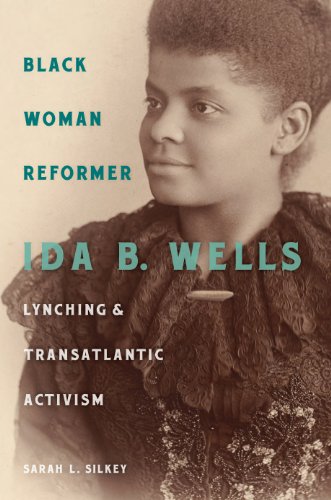
During the early 1890s, a series of shocking lynchings brought unprecedented international attention to American mob violence. This interest created an opportunity for Ida B. Wells, an African American journalist and civil rights activist from Memphis, to travel to England to cultivate British moral indignation against American lynching. Wells adapted race and gender roles established by African American abolitionists in Britain to legitimate her activism as a “black lady reformerâ€â€”a role American society denied her—and assert her right to defend her race from abroad. Based on extensive archival research conducted in the United States and Britain, Black Woman Reformer by Sarah Silkey explores Wells’s 1893–94 antilynching campaigns within the broader contexts of nineteenth-century transatlantic reform networks and debates about the role of extralegal violence in American society.
Through her speaking engagements, newspaper interviews, and the efforts of her British allies, Wells altered the framework of public debates on lynching in both Britain and the United States. No longer content to view lynching as a benign form of frontier justice, Britons accepted Wells’s assertion that lynching was a racially motivated act of brutality designed to enforce white supremacy. As British criticism of lynching mounted, southern political leaders desperate to maintain positive relations with potential foreign investors were forced to choose whether to publicly defend or decry lynching. Although British moral pressure and media attention did not end lynching, the international scrutiny generated by Wells’s campaigns transformed our understanding of racial violence and made American communities increasingly reluctant to embrace lynching.