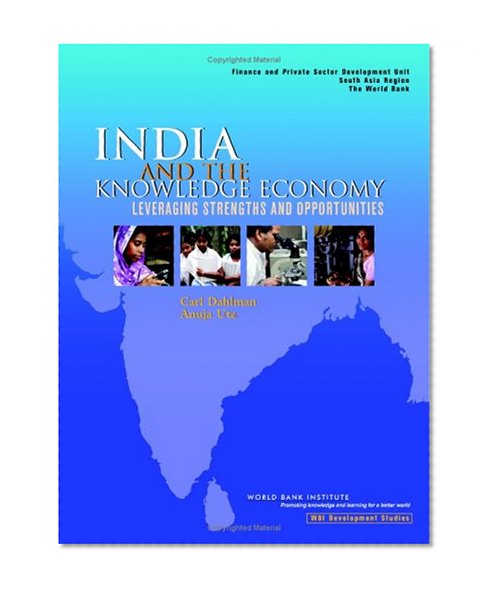
India and the Knowledge Economy: Leveraging Strengths and Opportunities (WBI Learning Resources Series)
📄 Viewing lite version
Full site ›
Book Details
Author(s)Carl Dahlman, Anuja Utz
PublisherWorld Bank Publications
ISBN / ASIN0821362070
ISBN-139780821362075
Sales Rank6,860,741
CategoryBusiness & Economics
MarketplaceUnited States 🇺🇸
Description ▲
In the global knowledge economy of the twenty-first century, India¡¦s development policy challenges will require it to use knowledge more effectively to raise the productivity of agriculture, industry, and services and reduce poverty. India has made tremendous strides in its economic and social development in the past two decades. Its impressive growth in recent years¡X8.2 percent in 2003¡Xcan be attributed to the far-reaching reforms embarked on in 1991 and to opening the economy to global competition. In addition, India can count on a number of strengths as it strives to transform itself into a knowledge-based economy¡Xavailability of skilled human capital, a democratic system, widespread use of English, macroeconomic stability, a dynamic private sector, institutions of a free market economy; a local market that is one of the largest in the world; a well-developed financial sector; and a broad and diversified science and technology infrastructure, and global niches in IT. But India can do more¡Xmuch more¡Xto leverage its strengths and grasp today¡¦s opportunities. India and the Knowledge Economy assesses India¡¦s progress in becoming a knowledge economy and suggests actions to strengthen the economic and institutional regime, develop educated and skilled workers, create an efficient innovation system, and build a dynamic information infrastructure. It highlights that to get the greatest benefits from the knowledge revolution, India will need to press on with the economic reform agenda that it put into motion a decade ago and continue to implement the various policy and institutional changes needed to accelerate growth. In so doing, it will be able to improve its international competitiveness and join the ranks of countries that are making a successful transition to the knowledge economy.
More Books in Business & Economics
Business Cycles and Forecasting
View
Development Economics: Its Position in the Present Sta…
View
Cost Systems Design
View
So You Want to Dance on Broadway
View
The Blueprint: Reviving Innovation, Rediscovering Risk…
View
Managing IT Outsourcing, Second Edition
View
Education and the Creation of Capital in the Early Ame…
View
Global Corruption Report 2005: Special Focus: Corrupti…
View
More Tales for Trainers: Using Stories and Metaphors t…
View