The Scandal of the State develops through a series of compelling case studies, each of which centers around an incident exposing the contradictory position of the Indian state vis-à -vis its female citizens and, ultimately, the inadequacy of its commitment to women’s rights. Sunder Rajan focuses on the custody battle over a Muslim child bride, the compulsory sterilization of mentally retarded women in state institutional care, female infanticide in Tamilnadu, prostitution as labor rather than crime, and the surrender of the female outlaw Phoolan Devi. She also looks at the ways the Uniform Civil Code presented many women with a stark choice between allegiance to their religion and community or the secular assertion of individual rights. Rich with theoretical acumen and activist passion, The Scandal of the State is a powerful critique of the mutual dependence of women and the state on one another in the specific context of a postcolonial modernity.
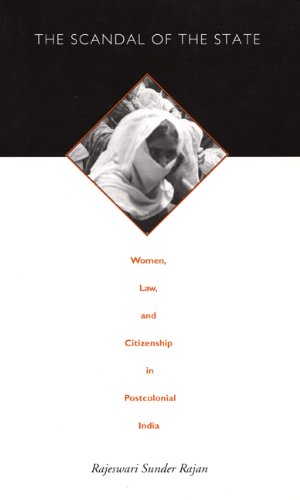
The Scandal of the State: Women, Law, and Citizenship in Postcolonial India (Next Wave: New Directions in Women's Studies)
📄 Viewing lite version
Full site ›
Book Details
Author(s)Rajeswari Sunder Rajan
PublisherDuke University Press Books
ISBN / ASIN0822330482
ISBN-139780822330486
AvailabilityIn stock. Usually ships within 2 to 3 days.
Sales Rank2,154,299
MarketplaceUnited States 🇺🇸
Description ▲
The Scandal of the State is a revealing study of the relationship between the postcolonial, democratic Indian nation-state and Indian women’s actual needs and lives. Well-known for her work combining feminist theory and postcolonial studies, Rajeswari Sunder Rajan shows how the state is central to understanding women’s identities and how, reciprocally, women and “women’s issues†affect the state’s role and function. She argues that in India law and citizenship define for women not only the scope of political rights but also cultural identity and everyday life. Sunder Rajan delineates the postcolonial state in implicit contrast with the “enlightened,†postfeminist neoliberal state in the West. Her analysis wrestles with complex social realities, taking into account the influence of age, ethnicity, religion, and class on individual and group identities as well as the shifting, heterogeneous nature of the state itself.