Beginning in the late 1840s, subaltern groups entered the political arena to forge alliances, both temporary and enduring, with the elite Liberal and Conservative Parties. In the process, each group formed its own political discourses and reframed republicanism to suit its distinct needs. These popular liberals and popular conservatives bargained for the parties’ support and deployed a broad repertoire of political actions, including voting, demonstrations, petitions, strikes, boycotts, and armed struggle. By the 1880s, though, many wealthy Colombians of both parties blamed popular political engagement for social disorder and economic failure, and they successfully restricted lower-class participation in politics. Sanders suggests that these reactionary developments contributed to the violence and unrest afflicting modern Colombia. Yet in illuminating the country’s legacy of participatory politics in the nineteenth century, he shows that the current situation is neither inevitable nor eternal.
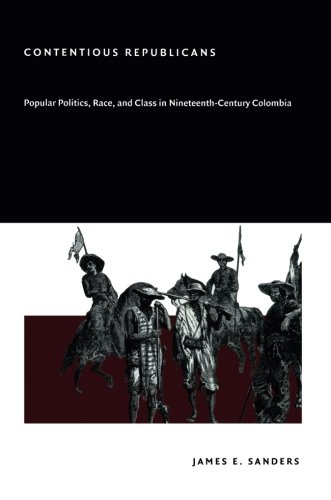
Contentious Republicans: Popular Politics, Race, and Class in Nineteenth-Century Colombia
📄 Viewing lite version
Full site ›
Book Details
Author(s)James E. Sanders
PublisherDuke University Press
ISBN / ASIN0822332248
ISBN-139780822332244
AvailabilityUsually ships in 24 hours
Sales Rank1,690,551
MarketplaceUnited States 🇺🇸
Description ▲
Contentious Republicans explores the mid-nineteenth-century rise of mass electoral democracy in the southwestern region of Colombia, a country many assume has never had a meaningful democracy of any sort. James E. Sanders describes a surprisingly rich republicanism characterized by legal rights and popular participation, and he explains how this vibrant political culture was created largely by competing subaltern groups seeking to claim their rights as citizens and their place in the political sphere. Moving beyond the many studies of nineteenth-century nation building that focus on one segment of society, Contentious Republicans examines the political activism of three distinct social and racial groups: Afro-Colombians, Indians, and white peasant migrants.
Similar Products ▼
- Enrique's Journey: The Story of a Boy's Dangerous Odyssey to Reunite with His Mother
- Peru's Indian Peoples and the Challenge of Spanish Conquest: Huamanga to 1640
- The Massacre at El Mozote
- Dangerous Speech: A Social History of Blasphemy in Colonial Mexico
- Born in Blood & Fire: A Concise History of Latin America, Second Edition
- The Colombia Reader: History, Culture, Politics (The Latin America Readers)
- Rafael Nunez and the Politics of Colombian Regionalism, 1863-1886
- Afro-Latin America, 1800-2000
- Introductory Statistics: Exploring the World Through Data
- Dulcinea in the Factory: Myths, Morals, Men, and Women in Colombia’s Industrial Experiment, 1905–1960 (Comparative and International Working-Class History)