Search Books
The Remasculinization of Ko…

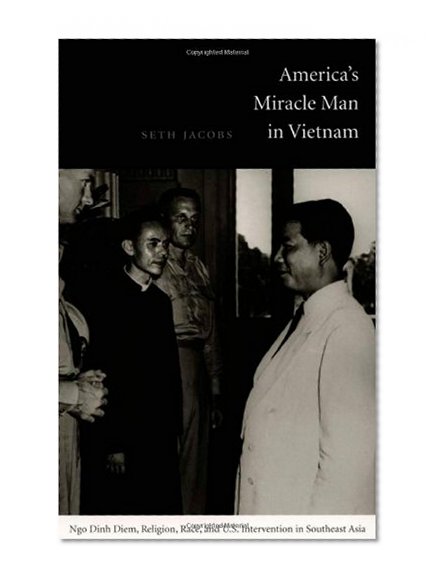
America's Miracle Man in Vietnam: Ngo Dinh Diem, Religion, Race, and U.S. Intervention in Southeast Asia (American Encounters/Global Interactions)

Author Seth Jacobs
Publisher Duke University Press Books
Category History
📄 Viewing lite version Full site ›
🌎 Shop on Amazon — choose country
⌛ 🇫🇷 France pricing being fetched… Prices will appear once fetched — usually within a few minutes.
Share:
Book Details
Author(s)Seth Jacobs
ISBN / ASIN0822334402
ISBN-139780822334408
CategoryHistory
MarketplaceFrance 🇫🇷

Description

America’s Miracle Man in Vietnam rethinks the motivations behind one of the most ruinous foreign-policy decisions of the postwar era: America’s commitment to preserve an independent South Vietnam under the premiership of Ngo Dinh Diem. The so-called Diem experiment is usually ascribed to U.S. anticommunism and an absence of other candidates for South Vietnam’s highest office. Challenging those explanations, Seth Jacobs utilizes religion and race as categories of analysis to argue that the alliance with Diem cannot be understood apart from America’s mid-century religious revival and policymakers’ perceptions of Asians. Jacobs contends that Diem’s Catholicism and the extent to which he violated American notions of “Oriental” passivity and moral laxity made him a more attractive ally to Washington than many non-Christian South Vietnamese with greater administrative experience and popular support.

A diplomatic and cultural history, America’s Miracle Man in Vietnam draws on government archives, presidential libraries, private papers, novels, newspapers, magazines, movies, and television and radio broadcasts. Jacobs shows in detail how, in the 1950s, U.S. policymakers conceived of Cold War anticommunism as a crusade in which Americans needed to combine with fellow Judeo-Christians against an adversary dangerous as much for its atheism as for its military might. He describes how racist assumptions that Asians were culturally unready for democratic self-government predisposed Americans to excuse Diem’s dictatorship as necessary in “the Orient.” By focusing attention on the role of American religious and racial ideologies, Jacobs makes a crucial contribution to our understanding of the disastrous commitment of the United States to “sink or swim with Ngo Dinh Diem.”

The Bet, and Other Stories
View
Pakistan and the Bomb: Public Opinion and Nuclear Opti…
View
Writing National Histories: Western Europe Since 1800
View
Empire in Eclipse
View
Monks and Laymen in Byzantium, 843-1118
View
The Wilmington and Western Railroad (Images of Rail: D…
View
Black Sailor, White Navy: Racial Unrest in the Fleet d…
View
Feasibility of Laser Power Transmission to a High-Alti…
View
The Democratic Republic: 1801-1815
View