Gopinath juxtaposes diverse texts to indicate the range of oppositional practices, subjectivities, and visions of collectivity that fall outside not only mainstream narratives of diaspora, colonialism, and nationalism but also most projects of liberal feminism and gay and lesbian politics and theory. She considers British Asian music of the 1990s alongside alternative media and cultural practices. Among the fictional works she discusses are V. S. Naipaul’s classic novel A House for Mr. Biswas, Ismat Chughtai’s short story “The Quilt,” Monica Ali’s Brick Lane, Shyam Selvadurai’s Funny Boy, and Shani Mootoo’s Cereus Blooms at Night. Analyzing films including Deepa Mehta’s controversial Fire and Mira Nair’s Monsoon Wedding, she pays particular attention to how South Asian diasporic feminist filmmakers have reworked Bollywood’s strategies of queer representation and to what is lost or gained in this process of translation. Gopinath’s readings are dazzling, and her theoretical framework transformative and far-reaching.
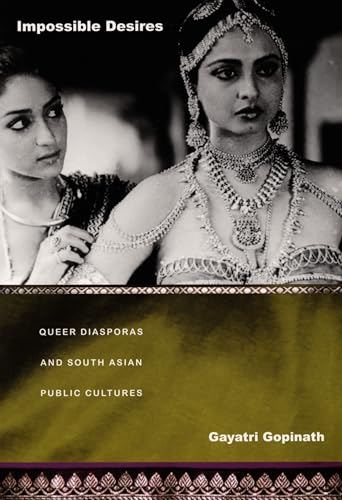
Impossible Desires: Queer Diasporas and South Asian Public Cultures (Perverse Modernities: A Series Edited by Jack Halberstam and Lisa Lowe)
📄 Viewing lite version
Full site ›
Book Details
Author(s)Gayatri Gopinath
PublisherDuke University Press Books
ISBN / ASIN0822335131
ISBN-139780822335139
AvailabilityUsually ships in 24 hours
Sales Rank319,248
CategorySocial Science
MarketplaceUnited States 🇺🇸
Description ▲
By bringing queer theory to bear on ideas of diaspora, Gayatri Gopinath produces both a more compelling queer theory and a more nuanced understanding of diaspora. Focusing on queer female diasporic subjectivity, Gopinath develops a theory of diaspora apart from the logic of blood, authenticity, and patrilineal descent that she argues invariably forms the core of conventional formulations. She examines South Asian diasporic literature, film, and music in order to suggest alternative ways of conceptualizing community and collectivity across disparate geographic locations. Her agile readings challenge nationalist ideologies by bringing to light that which has been rendered illegible or impossible within diaspora: the impure, inauthentic, and nonreproductive.
Similar Products ▼
- Disidentifications: Queers Of Color And The Performance Of Politics (Cultural Studies of the Americas)
- Unruly Visions: The Aesthetic Practices of Queer Diaspora (Perverse Modernities: A Series Edited by Jack Halberstam and Lisa Lowe)
- This Bridge Called My Back, Fourth Edition: Writings by Radical Women of Color
- Sexual Futures, Queer Gestures, and Other Latina Longings (Sexual Cultures)
- Aberrations In Black: Toward A Queer Of Color Critique (Critical American Studies)
- The Right to Maim: Debility, Capacity, Disability (ANIMA: Critical Race Studies Otherwise)
- The Totally Awesome Hulk Vol. 3: Big Apple Showdown (The Totally Awesome Hulk (2016))
- Asian Americans and the Media
- A View from the Bottom: Asian American Masculinity and Sexual Representation (Perverse Modernities: A Series Edited by Jack Halberstam and Lisa Lowe)
- Global Divas: Filipino Gay Men in the Diaspora (Perverse Modernities: A Series Edited by Jack Halberstam and Lisa Lowe)
More Books in Social Science
Introduction to the Sociology of Development
View
The Career Mystique: Cracks in the American Dream
View
Three Studies on Egyptian Feasts and their Chronologic…
View
American People Of Austrian Descent, including: Arnold…
View
World Wrestling Entertainment Championships, including…
View
Fetish Artists, including: John Willie, Robert Bishop …
View
Fictional Irish People, including: Leopold Bloom, Arte…
View
Sound Alliances: Indigenous Peoples, Cultural Politics…
View
Andean Entrepreneurs: Otavalo Merchants and Musicians …
View