Combining feminist theory, queer theory, psychoanalysis, deconstruction, and literary criticism, Freccero takes up a series of theoretical and historical issues related to debates in queer theory, feminist theory, the history of sexuality, and early modern studies. She juxtaposes readings of early and late modern texts, discussing the lyric poetry of Petrarch, Louise Labé, and Melissa Ethridge; David Halperin’s take on Michel Foucault via Apuleius’s The Golden Ass and Boccaccio’s Decameron; and France’s domestic partner legislation in connection with Marguerite de Navarre’s Heptameron. Turning to French cleric Jean de Léry’s account, published in 1578, of having witnessed cannibalism and religious rituals in Brazil some twenty years earlier and to the twentieth-century Brandon Teena case, Freccero draws on Jacques Derrida’s concept of spectrality to propose both an ethics and a mode of interpretation that acknowledges and is inspired by the haunting of the present by the past.
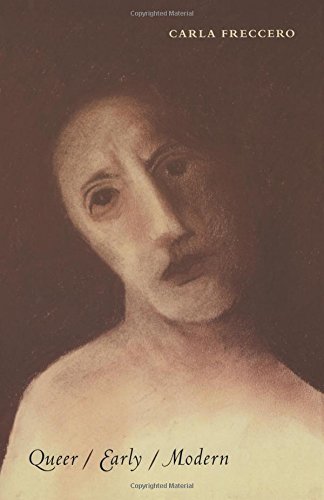
Queer/Early/Modern (Series Q)
📄 Viewing lite version
Full site ›
Book Details
Author(s)Carla Freccero
PublisherDuke University Press Books
ISBN / ASIN0822336901
ISBN-139780822336907
AvailabilityUsually ships in 24 hours
Sales Rank1,394,653
CategorySocial Science
MarketplaceUnited States 🇺🇸
Description ▲
In Queer/Early/Modern, Carla Freccero, a leading scholar of early modern European studies, argues for a reading practice that accounts for the queerness of temporality, for the way past, present, and future time appear out of sequence and in dialogue in our thinking about history and texts. Freccero takes issue with New Historicist accounts of sexual identity that claim to respect historical proprieties and to derive identity categories from the past. She urges us to see how the indeterminacies of subjectivity found in literary texts challenge identitarian constructions and she encourages us to read differently the relation between history and literature. Contending that the term “queer,” in its indeterminacy, points the way toward alternative ethical reading practices that do justice to the aftereffects of the past as they live on in the present, Freccero proposes a model of “fantasmatic historiography” that brings together history and fantasy, past and present, event and affect.
More Books in Social Science
Introduction to the Sociology of Development
View
The Career Mystique: Cracks in the American Dream
View
Three Studies on Egyptian Feasts and their Chronologic…
View
American People Of Austrian Descent, including: Arnold…
View
World Wrestling Entertainment Championships, including…
View
Fetish Artists, including: John Willie, Robert Bishop …
View
Fictional Irish People, including: Leopold Bloom, Arte…
View
Sound Alliances: Indigenous Peoples, Cultural Politics…
View
Andean Entrepreneurs: Otavalo Merchants and Musicians …
View