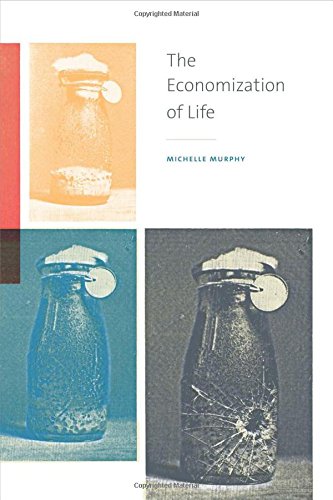
The Economization of Life
📄 Viewing lite version
Full site ›
Book Details
Author(s)Michelle Murphy
PublisherDuke University Press Books
ISBN / ASIN0822363453
ISBN-139780822363453
AvailabilityUsually ships in 24 hours
Sales Rank496,384
MarketplaceUnited States 🇺🇸
Description ▲
What is a life worth? In the wake of eugenics, new quantitative racist practices that valued life for the sake of economic futures flourished. In The Economization of Life, Michelle Murphy provocatively describes the twentieth-century rise of infrastructures of calculation and experiment aimed at governing population for the sake of national economy, pinpointing the spread of a potent biopolitical logic: some must not be born so that others might live more prosperously. Resituating the history of postcolonial neoliberal technique in expert circuits between the United States and Bangladesh, Murphy traces the methods and imaginaries through which family planning calculated lives not worth living, lives not worth saving, and lives not worth being born. The resulting archive of thick data transmuted into financialized “Invest in a Girl” campaigns that reframed survival as a question of human capital. The book challenges readers to reject the economy as our collective container and to refuse population as a term of reproductive justice.
Similar Products ▼
- A Billion Black Anthropocenes or None (Forerunners: Ideas First)
- Staying with the Trouble: Making Kin in the Chthulucene (Experimental Futures)
- Dark Matters: On the Surveillance of Blackness
- Arts of Living on a Damaged Planet: Ghosts and Monsters of the Anthropocene
- The Right to Maim: Debility, Capacity, Disability (ANIMA: Critical Race Studies Otherwise)
- Making Kin not Population: Reconceiving Generations (Paradigm)
- Seizing the Means of Reproduction: Entanglements of Feminism, Health, and Technoscience (Experimental Futures)
- Improvising Medicine: An African Oncology Ward in an Emerging Cancer Epidemic
- Living a Feminist Life
- The Mushroom at the End of the World: On the Possibility of Life in Capitalist Ruins