"Taken as a trilogy, consent not to be a single being is a monumental accomplishment: a brilliant theoretical intervention that might be best described as a powerful case for blackness as a category of analysis."—Brent Hayes Edwards, author of Epistrophies: Jazz and the Literary Imagination
In The Universal Machine—the concluding volume to his landmark trilogy consent not to be a single being—Fred Moten presents a suite of three essays on Emmanuel Levinas, Hannah Arendt, and Frantz Fanon, in which he explores questions of freedom, capture, and selfhood. In trademark style, Moten considers these thinkers alongside artists and musicians such as William Kentridge and Curtis Mayfield while interrogating the relation between blackness and phenomenology. Whether using Levinas's idea of escape in unintended ways, examining Arendt's antiblackness through Mayfield's virtuosic falsetto and Anthony Braxton's musical language, or showing how Fanon's form of phenomenology enables black social life, Moten formulates blackness as a way of being in the world that evades regulation. Throughout The Universal Machine—and the trilogy as a whole—Moten's theorizations of blackness will have a lasting and profound impact.
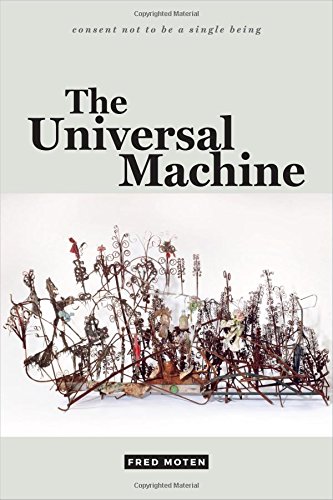
The Universal Machine (consent not to be a single being)
📄 Viewing lite version
Full site ›
Book Details
Author(s)Fred Moten
PublisherDuke University Press Books
ISBN / ASIN0822370557
ISBN-139780822370550
AvailabilityUsually ships in 24 hours
Sales Rank74,923
MarketplaceUnited States 🇺🇸
Description ▲
Similar Products ▼
- Stolen Life (consent not to be a single being)
- Black and Blur (consent not to be a single being)
- Ontological Terror: Blackness, Nihilism, and Emancipation
- The Undercommons: Fugitive Planning & Black Study
- In The Break: The Aesthetics Of The Black Radical Tradition
- Carceral Capitalism (Semiotext(e) / Intervention Series)
- In the Wake: On Blackness and Being
- Alienation and Freedom
- Whither Fanon? (Cultural Memory in the Present)
- Black Masculinity and the Cinema of Policing