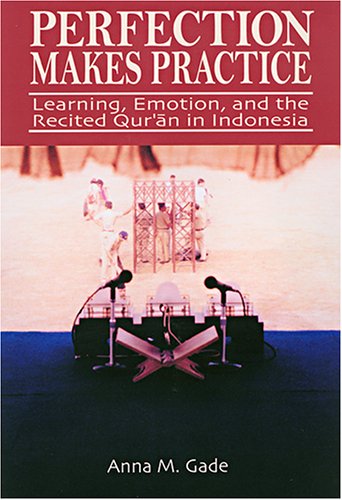
What sustains such voluntary and energetic Qur'anic practice at both the individual and collective levels? Anna Gade concludes that "moods and motivations," foundational to the definition of religion given by Clifford Geertz, progressively compel Indonesian Muslims' interest to undertake longterm projects to improve their ability to recite the Qur'an. Gade's approach combines ethnography, ethnomusicology, material from classical Qur'anic and Islamic studies, fresh theory on ritual and experience, as well as perspectives on the global connections of Muslim thought and action. Her work considers the developmental and affective aspects of ongoing, increasing, and escalating religious involvement as well as the emotional textures and learning trajectories that enhance or sustain long-term religious effort.
The study's rich material and analysis provide a new focus for observers who attempt to "read" transnational religious revitalization movements within regional contexts, as well as Islamicists seeking to understand developing trends in Muslim systems. By highlighting the "learner's point of view" in close treatments of text and context, Perfection Makes Practice represents an anthropology of Qur'anic traditions outside of the Arabic-speaking world, suggesting ways to apprehend the depth of Qur'anic piety in contemporary Muslim-majority and Muslim-minority societies.