Despite enormous advances made in the development of external effector prosthetics over the last quarter century, significant questions remain, especially those concerning signal degradation that occurs with chronically implanted neuroelectrodes.
Offering contributions from pioneering researchers in neuroprosthetics and tissue repair, Indwelling Neural Implants: Strategies for Contending with the In Vivo Environment examines many of these challenges, paying particular attention to how the healing of tissues surrounding an implant can impact the intended use of a device. The contributions are divided into four sections
·        Part one examines wound healing from the initial insertion trauma through the inflammatory and repair process, explaining how the action of healing varies throughout different areas of the body.Â
·        Part two considers various performance issues specific to particular implant components, including those that arise from the chemical, mechanical, thermal, and electrical impact on surrounding tissues. It discusses challenges that result from chronic tissue stimulation and heat effects that occur with on-chip and telemetric processing.
·        Part three presents both in vitro and in vivo approaches to assessing wound healing response to materials. It includes the contribution of the developer of a chronic hollow fiber membrane implant who explains how an in vivo model is used to  assess molecular transport in brain tissue surrounding the implant.
·        The final section evaluates molecular and materials strategies for intervening in CNS wound repair and enhancing the electrical communication between the electrode surface and the surrounding tissue. It also presents novel approaches to nerve regeneration and repair.
This seminal work provides researchers with an up-to-date account of the progress in the field that they can build upon to bring us closer to realizing the full value of neural implants in combating otherwise intractable human health problems.
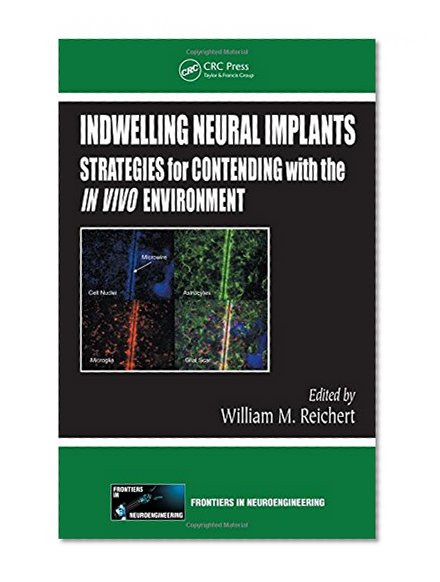
Indwelling Neural Implants: Strategies for Contending with the In Vivo Environment (Frontiers in Neuroengineering Series)
📄 Viewing lite version
Full site ›
Book Details
PublisherCRC Press
ISBN / ASIN0849393620
ISBN-139780849393624
AvailabilityUsually ships in 24 hours
Sales Rank5,354,218
MarketplaceUnited States 🇺🇸