How and why did experience and knowledge become separated? Is it possible to talk of an infancy of experience, a “dumb†experience? For Walter Benjamin, the “poverty of experience†was a characteristic of modernity, originating in the catastrophe of the First World War. For Giorgio Agamben, the Italian editor of Benjamin’s complete works, the destruction of experience no longer needs catastrophes: daily life in any modern city will suffice.
Agamben’s profound and radical exploration of language, infancy, and everyday life traces concepts of experience through Kant, Hegel, Husserl and Benveniste. In doing so he elaborates a theory of infancy that throws new light on a number of major themes in contemporary thought: the anthropological opposition between nature and culture; the linguistic opposition between speech and language; the birth of the subject and the appearance of the unconscious. Agamben goes on to consider time and history; the Marxist notion of base and superstructure (via a careful reading of the famous Adorno–Benjamin correspondence on Baudelaire’s Paris); and the difference between rituals and games. Beautifully written, erudite and provocative, these essays will be of great interest to students of philosophy, linguistics, anthropology and politics.
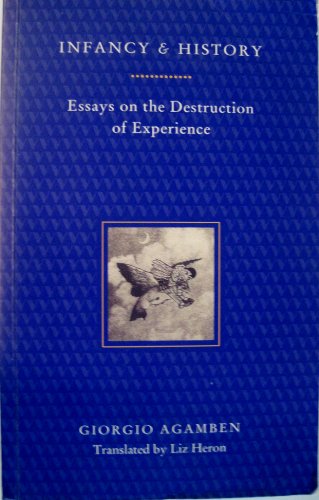
Infancy and History: The Destruction of Experience
📄 Viewing lite version
Full site ›
Book Details
Author(s)Giorgio Agamben
PublisherVerso
ISBN / ASIN0860916456
ISBN-139780860916451
Sales Rank4,057,225
CategoryPhilosophy
MarketplaceUnited States 🇺🇸
Description ▲
More Books in Philosophy
Moralizing Technology: Understanding and Designing the…
View
The Philosophy of Quantum Mechanics: An Interactive In…
View
The Philosophy Of Nationalism
View
Philosophy in Pakistan (Cultural Heritage and Contempo…
View
God and Humans in Islamic Thought: Abd al-Jabbar, Ibn …
View
Four-Dimensionalism: An Ontology of Persistence and Ti…
View
Self-Awareness, Temporality, and Alterity: Central Top…
View
Islamic Philosophy
View
Invisible Acts of Power: Channeling Grace in Your Ever…
View