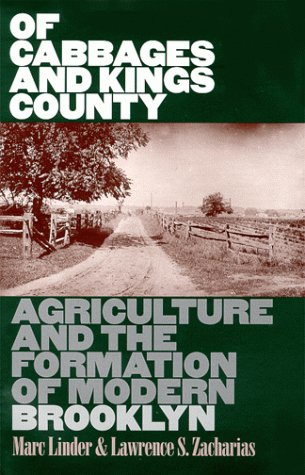
No one today thinks of Brooklyn, New York, as an agricultural center. Yet Kings County enjoyed over two centuries of farming prosperity. Even as late as 1880 it was one of the nation's leading vegetable producers, second only to neighboring Queens County.
In Of Cabbages and Kings County, Marc Linder and Lawrence Zacharias reconstruct the history of a lost agricultural community. Their study focuses on rural Kings County, the site of Brooklyn's tremendous expansion during the latter part of the nineteenth century. In particular, they question whether sprawl was a necessary condition of American industrialization: could the agricultural base that preceded and surrounded the city have survived the onrush of residential real estate speculation with a bit of foresight and public policies that the politically outnumbered farmers could not have secured on their own?
The first part of the book reviews the county's Dutch American agricultural tradition, in particular its conversion after 1850 from extensive farming (e.g., wheat, corn) to intensive farming of market garden crops. The authors examine the growing competition between local farmers and their southern counterparts for a share of the huge New York City market, comparing farming conditions and factors such as labor and transportation.
In the second part of the book, the authors turn their attention to the forces that eventually destroyed Kings County's farming—ranging from the political and ideological pressures to modernize the city's rural surroundings to unplanned, market-driven attempts to facilitate transportation for more affluent city dwellers to recreational outlets on Coney Island and, once transportation was at hand, to replace farms with residential housing for the city's congested population.
Drawing on a vast range of archival sources, the authors refocus the history of Brooklyn to uncover what was lost with the expansion of the city. For today, as urban planners, ecologists, and agricultural developers reevaluate urban sprawl and the need for greenbelts or agricultural-urban balance, the lost opportunities of the past loom larger.