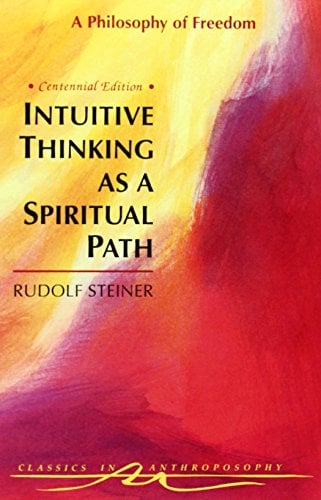
This seminal work asserts that free spiritual activity—understood as the human ability to think and act independently of physical nature—is the suitable path for human beings today to gain true knowledge of themselves and of the universe. This is not merely a philosophical volume, but rather a warm, heart-oriented guide to the practice and experience of living thinking.
Readers will not find abstract philosophy here, but a step-by-step account of how a person may come to experience living, intuitive thinking—“the conscious experience of a purely spiritual content.”
During the past hundred years since it was written, many have tried to discover this “new thinking” that could help us understand the various spiritual, ecological, social, political, and philosophical issues facing us. But only Rudolf Steiner laid out a path that leads from ordinary thinking to the level of pure spiritual activity—intuitive thinking—in which we become co-creators and co-redeemers of the world.
“When, with the help of Steiner’s book, we recognize that thinking is an essentially spiritual activity, we discover that it can school us. In that sense—Steiner’s sense—thinking is a spiritual path” (Gertrude Reif Hughes).
Contents:
- Translator’s Introduction
- Introduction by Gertrude Reif Hughes
- Preface to the Revised Edition, 1918
- Part 1: Theory: The Knowledge of Freedom
- Conscious Human Action
- The Fundamental Urge for Knowledge
- Thinking in the Service of Understanding the World
- The World as Percept
- Knowing the World
- Human Individuality
- Are There Limits to Cognition?
- Part 2: Practice: The Reality of Freedom
- The Factors of Life
- The Idea of Freedom
- Freedom―Philosophy and Monism
- World Purpose and Life Purpose (Human Destiny)
- Moral Imagination (Darwinism and Ethics)
- The Value of Life (Pessimism and Optimism)
- Individuality and Genus
- Final Questions: The Consequences of Monism
- Appendixes
- Bibliography
- Index
This volume is arguably the most essential of Steiner’s works. The thoughts in this book establish the foundation for all of Anthroposophy.
Other translations: The Philosophy of Freedom and The Philosophy of Spiritual Activity. German edition: Die Philosophie der Freiheit