Search Books
The Law of Attraction: And … The Thinker's Guide to Clin…

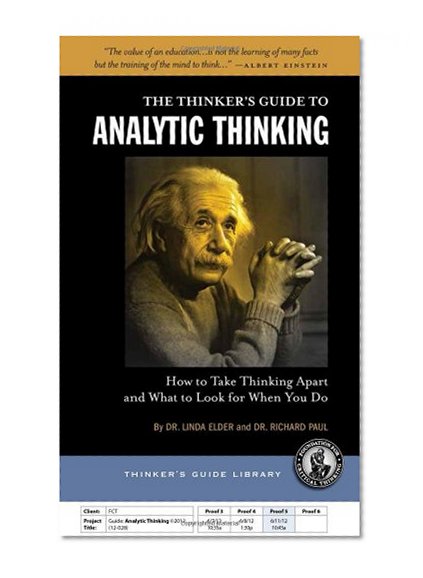
Thinker's Guide to Analytic Thinking: How to Take Thinking Apart and What to Look for When You Do

Author Linda Elder, Richard Paul
Publisher Foundation for Critical Thinking
Category Philosophy
📄 Viewing lite version Full site ›
🌎 Shop on Amazon — choose country
26.25 USD
🛒 Buy New on Amazon 🇺🇸 🏷 Buy Used — $19.99
Share:
Book Details
ISBN / ASIN0944583199
ISBN-139780944583197
Sales Rank97,671
CategoryPhilosophy
MarketplaceUnited States 🇺🇸

Description

This guide focuses on the intellectual skills that enable one to analyze anything one might think about - questions, problems, disciplines, subjects, etc. It provides the common denominator between all forms of analysis. Why a Guide on Analytic Thinking? Analysis and evaluation are recognized as crucial skills for all students to master. And for good reason. These skills are required in learning any significant body of content in a non-trivial way. There are many varieties of analysis specific to particular disciplines and technical practices. These forms of analysis often require technical training of a specialized nature. For example, one cannot do qualitative analysis in chemistry without instruction in chemistry. What we have provided in this guide, however, is the common denominator between all forms of analysis because all forms require thoughtful application and all thought presupposes the elements of thought. For example, one cannot think analytically FOR NO PURPOSE. Or think analytically, with NO QUESTION in mind. In order to develop the analytic mind, there must be guidance, instruction, and practice in monitoring thinking using intellectual tools applicable to every discipline. Everyone needs to learn to question purposes, goals, problem definitions, information, concepts, etc. It is these interdisciplinary analytic tools that enable those skilled in them to understand and assess their analytic thinking, whether in a highly technical area or in an everyday personal application. It is these analytic tools that enable one to get at the most fundamental logic of any discipline, subject, problem, or issue. They provide the means for transfer of learning between and among subjects and disciplines. They enable motivated persons to gain an overview of their learning in any and every situation analyzed, to think their way into and out of various intellectual domains. This thinker's guide serves as a launching pad toward analytic proficiency.
The New Spirit-Controlled Woman
View
Nine-Headed Dragon River: Zen Journals 1969-1982 (Sham…
View
The Essence of Jung's Psychology and Tibetan Buddhism:…
View
The Illustrated Encyclopedia of Buddhism: A Comprehens…
View
Tantric Wisdom for Today's World: The New Yoga of Awar…
View
The Black Mirror: Looking at Life through Death
View
Philosophy For Dummies, UK Edition
View
Daybreak: Thoughts on the Prejudices of Morality (Camb…
View