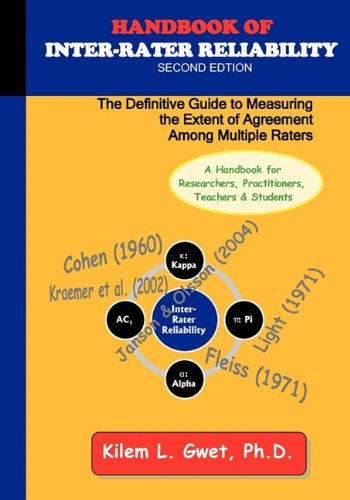
Handbook of Inter-Rater Reliability (Second Edition)
📄 Viewing lite version
Full site ›
Book Details
Author(s)Kilem Li Gwet
PublisherAdvanced Analytics, LLC
ISBN / ASIN0970806248
ISBN-139780970806246
AvailabilityIn stock. Usually ships within 2 to 3 days.
Sales Rank7,308,286
MarketplaceUnited States 🇺🇸
Description ▲
Note to readers: This book has a more complete third edition already available on Amazon.com.
This book presents various methods for calculating the extent of agreement among raters for different types of ratings. Some of the methods initially developed for nominal-scale ratings only, are extended in this book to ordinal and interval scales as well. To ensure an adequate level of sophistication in the treatment of this topic, the precision aspects associated with the agreement coefficients are treated. New methods begin with the simple scenario of 2 raters and 2 response categories before being extended to the more complex situation of multiple raters, and multiple-level nominal, ordinal and interval scales. Cohen's Kappa coefficient is one of the most widely-used agreement coefficients among researchers, despite its tendency to yield controversial results. Kappa and its various versions have raised concerns among practitioners and showed limitations, which are well-documented in the literature. This book discusses numerous alternatives, and proposes a new framework of analysis that allows researchers to gain further insight into the core issues related to the interpretation of the coefficients' magnitude, in addition to providing a common framework for evaluating the merit of different approaches. The author explains in a clear and intuitive fashion the motivations and assumptions underlying each technique discussed in the book. He demonstrates the benefits of using basic level statistical thinking in the design and analysis of inter-rater reliability experiments. The interpretation and limitations of various techniques are extensively discussed. From optimizing the design of the inter-rater reliability study to validating the computed agreement coefficients, the author's step-by-step approach is practical, easy to understand and will put all practitioners on the path to achieving their data quality objectives.