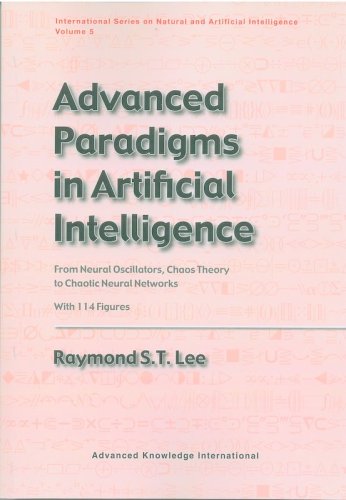
Advanced Paradigms in Artificial Intelligence (Natural and Artifical Intelligence)
📄 Viewing lite version
Full site ›
Book Details
Author(s)Raymond S. T. Lee
PublisherAdvanced Knowledge International
ISBN / ASIN0975215035
ISBN-139780975215036
AvailabilityUsually ships in 24 hours
Sales Rank9,334,183
MarketplaceUnited States 🇺🇸
Description ▲
Artifical Intelligence (AI) has been explored by scientists over centuries. It is not only related to the field of natural science, it is also closely related to different disciplines including: philosophy, psychology, neuroscience, physics and physiology. The aim of this book is to present the latest research works and developments in the field of contemporary AI, Chaos Theory and Chaotic Neural Networks. Besides, the author presents his latest research in these fields, particularly his Cognitron Theory. Also, the author presents how this chaotic neuro-oscillatory theory can be adopted to interpret Gestalt Theory, Modern Ontology and Epistemology, which believes to be the "keys" of human minds and the source of intelligence. This book is divided into THREE Parts. Part 1 is an introduction on both the concepts and applications of the advanced paradigms in AI including: Artificial Neural Networks, Fuzzy Theory, Oscillatory Theory (and Neural Oscillators), Chaos Theory and Fractals. Part 2 focuses on the concepts and theories of the Chaotic Neural Networks. The author presents his latest works on Lee-oscillator and its chaotic neuro-dynamics for the interpretation of the remarkable psycology behaviours – the Gestalt Theory. Part 3 is an advance section focuses on the latest works and research done by the author on Chaotic Neural Networks – the Cognitron Theory and its interpretation in Modern Ontology and Epistemology. In addition to the discussions of the underlying principles of the advanced paradigms in AI, this book also covers a wide range of application areas including: Stock prediction; Agent-based e-shopping system; Scene segmentation and analysis; Severe weather prediction; Invariant human face recognition; Gestalt phenomena; Cognitive agents and Ontological agent-based system.