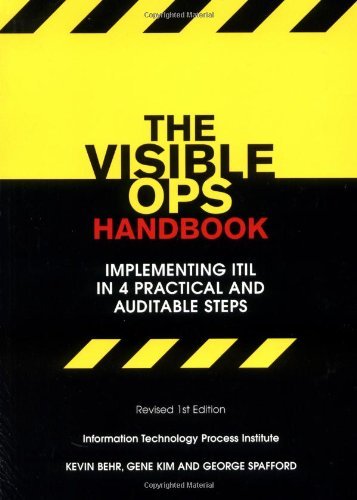
The Visible Ops Handbook: Implementing ITIL in 4 Practical and Auditable Steps
📄 Viewing lite version
Full site ›
Book Details
Author(s)Kevin Behr
ISBN / ASIN0975568612
ISBN-139780975568613
AvailabilityIn Stock.
Sales Rank171,075
CategoryComputers
MarketplaceUnited States 🇺🇸
Description ▲
The Core of Visible Ops Visible Ops is a methodology designed to jumpstart implementation of controls and process improvement in IT organizations needing to increase service levels, security, and auditability while managing costs. Visible Ops is comprised of four prescriptive and self-fueling steps that take an organization from any starting point to a continually improving process. Making ITIL Actionable Although the Information Technology Infrastructure Library (ITIL) provides a wealth of best practices, it lacks prescriptive guidance: What do you implement first, and how do you do it? Moreover, the ITIL books remain relatively expensive to distribute. Other information, publicly available from a variety of sources, is too general and vague to effectively aid organizations that need to start or enhance process improvement efforts. The Visible Ops booklet provides a prescriptive roadmap for organizations beginning or continuing their IT process improvement journey. Why Do You Need Visible Ops? The Visible Ops methodology was developed because there was not a satisfactory answer to the question: “I believe in the need for IT process improvement, but where do I start?” Since 2000, Gene Kim and Kevin Behr have met with hundreds of IT organizations and identified eight high-performing IT organizations with the highest service levels, best security, and best efficiencies. For years, they studied these high-performing organizations to figure out the secrets to their success. Visible Ops codifies how these organizations achieved their transformation from good to great, showing how interested organizations can replicate the key processes of these high-performing organizations in just four steps: 1. Stabilize Patient, Modify First Response – Almost 80% of outages are self-inflicted. The first step is to control risky changes and reduce MTTR by addressing how changes are managed and how problems are resolved. 2. Catch and Release, Find Fragile Artifacts – Often, infrastructure exists that cannot be repeatedly replicated. In this step, we inventory assets, configurations and services, to identify those with the lowest change success rates, highest MTTR and highest business downtime costs. 3. Establish Repeatable Build Library – The highest return on investment is implementing effective release management processes. This step creates repeatable builds for the most critical assets and services, to make it “cheaper to rebuild than to repair.” 4. Enable Continuous Improvement – The previous steps have progressively built a closed-loop between the Release, Control and Resolution processes. This step implements metrics to allow continuous improvement of all of these process areas, to best ensure that business objectives are met.
Similar Products ▼
- Visible Ops Security: Achieving Common Security And IT Operations Objectives In 4 Practical Steps
- The DevOps Handbook: How to Create World-Class Agility, Reliability, and Security in Technology Organizations
- The Phoenix Project: A Novel about IT, DevOps, and Helping Your Business Win
- Visible Ops Private Cloud: From Virtualization to Private Cloud in 4 Practical Steps
- The Unicorn Project: A Novel about Developers, Digital Disruption, and Thriving in the Age of Data
- Visible Ops Security: Achieving Common Security and IT Operations Objectives in 4 Practical Steps
- Continuous Delivery: Reliable Software Releases through Build, Test, and Deployment Automation (Addison-Wesley Signature Series (Fowler))
- Accelerate: The Science of Lean Software and DevOps: Building and Scaling High Performing Technology Organizations
- ITIL foundation
- Toyota Kata: Managing People for Improvement, Adaptiveness and Superior Results
More Books in Computers
Algorithms For Interviews: A Problem Solving Approach …
View
Visualize This: The FlowingData Guide to Design, Visua…
View
The Data Warehouse Toolkit: The Complete Guide to Dime…
View
Lessons Learned in Software Testing: A Context-Driven …
View
Secrets and Lies: Digital Security in a Networked World
View
The Data Warehouse ETL Toolkit: Practical Techniques f…
View
Pattern-Oriented Software Architecture, A System of Pa…
View
Pattern Oriented Software Architecture Volume 5: On Pa…
View
Pattern-Oriented Software Architecture, A Pattern Lang…
View
Elements of Information Theory
View
Battery Management Systems: Design by Modelling (Phili…
View