Featured Guest Review by William J. Bernstein
There's something rotten at the core of the American financial system; we all know it.
Before I go any further, I'll have to put my own biases on the table. While I'm in general a big believer in the power of free markets, there are certain things they don't do particularly well. Consider, for example, airline safety. Free market fundamentalism would dictate leaving it in the hands of consumers, who would logically shun those companies that killed too many passengers. We're smarter than that, of course; in large part because of government regulation, the average year passes without a major airline crash. Ditto the interstate highway system; does anyone really believe that Smith's invisible hand would have produced anything like this gem at the heart of our economy had not Dwight Eisenhower not been so impressed with Hitler's autobahns?
Of course, there are some activities that the government should stay out of: it should regulate airlines, but it shouldn't run them; and it shouldn't produce food, automobiles, and almost all other goods. This begs a much larger question: just where do free markets fail?
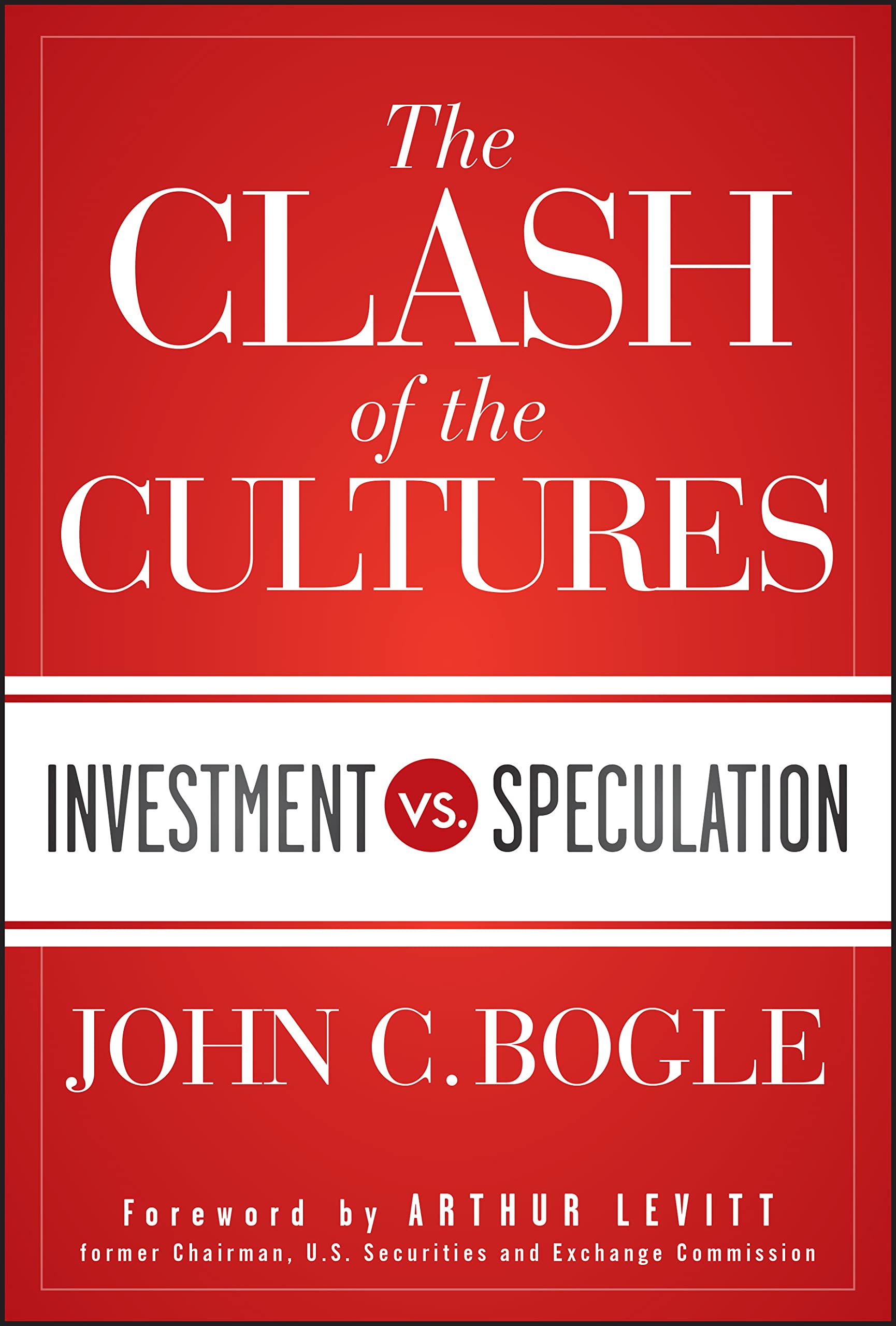
Which brings me to Jack Bogle's marvelous book about American finance, a system that, as we've seen in the past few years, has failed in a number of areas. As the author shows, it has done so by maximizing profits for managers, minimizing them for owners, and the customer be damned. For more than half a century, Mr. Bogle has not only observed this evolving spiral of immorality and self-interest from the inside, but has also been instrumental in creating, almost singlehandedly, what is thus far the major alternative to it: the customer-owned Vanguard Group.
There's a paradox at the heart of The Clash of the Cultures that should rivet any capital markets participant: just how is that the more market oriented an investment company is, the poorer are its results? The author recounts in painful detail the sorry performance of mutual funds managed by the large publicly traded financial companies, and the poor stewardship at the heart of that failure. The superb performance of the funds run by Vanguard, which is essentially a non-profit organization, stands in stark contrast. And it's not just Vanguard; it turns out that TIAA-CREF, which is also essentially a non-profit, the government-run Thrift Savings Plan, and privately held fund companies all do much better than large publicly traded finance companies. It's as if, say, the Red Cross, Department of Labor, and Salvation Army had all founded nonprofit automobile manufacturers that turned out better and cheaper cars than General Motors and Toyota.
Bogle identifies the speculative (as opposed to investment) mind set of the publicly traded companies as the chief culprit; because of their next-quarter/short-term focus, they trade frequently (as do their customers), pay scant attention to the costs of these activities, and often extract revenues from their funds and their shareholders in less ethical ways as well.
But that's only part of the story. The Clash of the Cultures gets to the heart of this remarkable and, for our nation, critical, conundrum of how in some economic spheres, nonprofits can outperform the invisible hand. It's required reading for every concerned citizen and every worried investor, and food for thought for anyone with an open mind and a curiosity about the world.
Featured Guest Review by William J. Bernstein
There's something rotten at the core of the American financial system; we all know it.
Before I go any further, I'll have to put my own biases on the table. While I'm in general a big believer in the power of free markets, there are certain things they don't do particularly well. Consider, for example, airline safety. Free market fundamentalism would dictate leaving it in the hands of consumers, who would logically shun those companies that killed too many passengers. We're smarter than that, of course; in large part because of government regulation, the average year passes without a major airline crash. Ditto the interstate highway system; does anyone really believe that Smith's invisible hand would have produced anything like this gem at the heart of our economy had not Dwight Eisenhower not been so impressed with Hitler's autobahns?
Of course, there are some activities that the government should stay out of: it should regulate airlines, but it shouldn't run them; and it shouldn't produce food, automobiles, and almost all other goods. This begs a much larger question: just where do free markets fail?
Which brings me to Jack Bogle's marvelous book about American finance, a system that, as we've seen in the past few years, has failed in a number of areas. As the author shows, it has done so by maximizing profits for managers, minimizing them for owners, and the customer be damned. For more than half a century, Mr. Bogle has not only observed this evolving spiral of immorality and self-interest from the inside, but has also been instrumental in creating, almost singlehandedly, what is thus far the major alternative to it: the customer-owned Vanguard Group.
There's a paradox at the heart of The Clash of the Cultures that should rivet any capital markets participant: just how is that the more market oriented an investment company is, the poorer are its results? The author recounts in painful detail the sorry performance of mutual funds managed by the large publicly traded financial companies, and the poor stewardship at the heart of that failure. The superb performance of the funds run by Vanguard, which is essentially a non-profit organization, stands in stark contrast. And it's not just Vanguard; it turns out that TIAA-CREF, which is also essentially a non-profit, the government-run Thrift Savings Plan, and privately held fund companies all do much better than large publicly traded finance companies. It's as if, say, the Red Cross, Department of Labor, and Salvation Army had all founded nonprofit automobile manufacturers that turned out better and cheaper cars than General Motors and Toyota.
Bogle identifies the speculative (as opposed to investment) mind set of the publicly traded companies as the chief culprit; because of their next-quarter/short-term focus, they trade frequently (as do their customers), pay scant attention to the costs of these activities, and often extract revenues from their funds and their shareholders in less ethical ways as well.
But that's only part of the story. The Clash of the Cultures gets to the heart of this remarkable and, for our nation, critical, conundrum of how in some economic spheres, nonprofits can outperform the invisible hand. It's required reading for every concerned citizen and every worried investor, and food for thought for anyone with an open mind and a curiosity about the world.