By necessity, Jill Lepore bases much of her research on a journal written in 1744 by New York Supreme Court Justice Daniel Horsmanden, which she describes as "one of the most startling and vexing documents in early American history" and "a diary, a mystery, a history, and maybe one of English literature's first detective stories." Adding cultural and political context to the available evidence, Lepore questions whether there was a conspiracy at all, or if it was blind fear run amok that led to the guilty verdicts for so many slaves. As she points out, fear of slave revolt was a real and consistent theme throughout the early days of the colonies. Crisply written and meticulously researched (the book includes several detailed appendices), New York Burning is a gripping narrative of events that led to what one colonist referred to as the "bonfires of the Negroes." --Shawn Carkonen
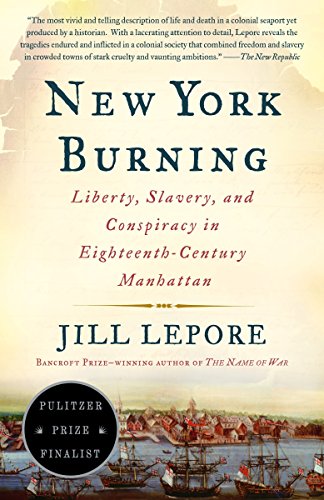
New York Burning: Liberty, Slavery, and Conspiracy in Eighteenth-Century Manhattan
📄 Viewing lite version
Full site ›
10.89
USD
🛒 Buy New on Amazon 🇺🇸
Book Details
Author(s)Jill Lepore,
PublisherVintage
ISBN / ASIN1400032261
ISBN-139781400032266
Sales Rank377,291
CategoryHistory
MarketplaceUnited States 🇺🇸
Description ▲
New York Burning is a well-told tale of a once-notorious episode that took place in Manhattan in 1741. Though, as Jill Lepore writes, New York's "slave past has long been buried," for most of the 18th century one in five inhabitants of Manhattan were enslaved, making it second only to Charleston, South Carolina, "in a wretched calculus of urban unfreedom." Over the course of a few weeks in 1741, ten fires burned across Manhattan, sparking hysteria and numerous conspiracy rumors. Initially, rival politicians blamed each other for the blazes, but they soon found a common enemy. Based solely on the testimony of one white woman, some 200 slaves were accused of conspiring to burn down the city, murder the resident whites, and take over the local government. Under duress, 80 slaves confessed to the crimes and were forced to implicate others. When the trial was over, 13 black men were burned at the stake, 17 more were hanged (along with four whites accused of working with them), and 70 others were shipped off to the Caribbean where slavery conditions were even worse.
More Books in History
Tutankhamen, Amenism, Atenism and Egyptian Monotheism,…
View
Barefoot on Crane Island: A Fond Reminiscence of Lake …
View
Critical Essays on Israeli Society, Religion, and Gove…
View
Flashpoint in Ukraine: How the US Drive for Hegemony R…
View
Militancy and Violence in West Africa (Contemporary Se…
View
The Confessions of Edward Isham: A Poor White Life of …
View
A Nation Transformed: England after the Restoration
View
Bunyan'S Devotional Works. the Spirit of Prayer: the S…
View