Search Books
Classroom Assessment & Grad… Managing Your Classroom wit…

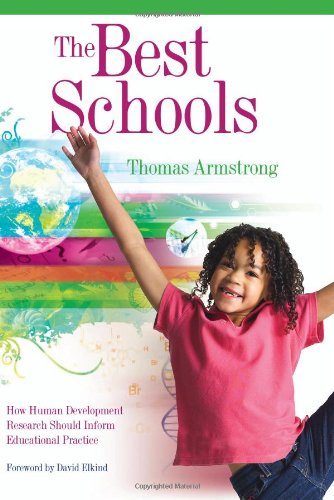
The Best Schools: How Human Development Research Should Inform Educational Practice

Author Thomas Armstrong Ph.D.
Publisher Association for Supervision & Curriculum Developme
Category Education
📄 Viewing lite version Full site ›
🌎 Shop on Amazon — choose country
3.50 23.95 USD
🛒 Buy New on Amazon 🇺🇸 🏷 Buy Used — $0.01

✓ Usually ships in 1-2 business days

Share:
Book Details
ISBN / ASIN141660457X
ISBN-139781416604570
AvailabilityUsually ships in 1-2 business days
Sales Rank578,875
CategoryEducation
MarketplaceUnited States 🇺🇸

Description

Educators, politicians, parents, and even students are consumed with speaking the language of academic achievement. Yet something is missing in the current focus on accountability, standardized testing, and adequate yearly progress. If schools continue to focus the conversation on rigor and accountability and ignore more human elements of education, many students may miss out on opportunities to discover the richness of individual exploration that schools can foster.

In The Best Schools, Armstrong urges educators to leave narrow definitions of learning behind and return to the great thinkers of the past 100 years—Montessori, Piaget, Freud, Steiner, Erikson, Dewey, Elkind, Gardner—and to the language of human development and the whole child.

The Best Schools highlights examples of educational programs that are honoring students’ differences, using developmentally appropriate practices, and promoting a humane approach to education that includes the following elements:
*An emphasis on play for early childhood learning.
*Theme- and project-based learning for elementary school students.
8Active learning that recognizes the social, emotional, and cognitive needs of adolescents in middle schools.
*Mentoring, apprenticeships, and cooperative education for high school students.

Educators in "the best schools" recognize the differences in the physical, emotional, cognitive, and spiritual worlds of students of different ages. This book will help educators reflect on how to help each student reach his or her true potential, how to inspire each child and adolescent to discover an inner passion to learn, and how to honor the unique journey of each individual through life.

Mind Maps For Kids: An Introduction
View
The Times Good University Guide 2011
View
The Times Good University Guide 2012
View
Writing: Learn to Write Better Academic Essays (Collin…
View
Research: Improve Your Reading and Referencing Skills …
View
Lectures: Learn Academic Listening and Note-Taking Ski…
View
Presenting: Deliver Academic Presentations with Confid…
View
Group Work: Work Together for Academic Success (Collin…
View
Numbers: Statistics and Data for the Non-Specialist (C…
View