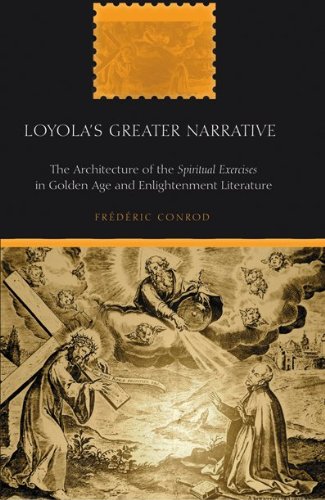
Loyola's Greater Narrative: The Architecture of the <I>Spiritual Exercises</I> in Golden Age and Enlightenment Literature (American University Studies Series II: Romance Languages and Literature)
📄 Viewing lite version
Full site ›
Book Details
Author(s)Frédéric Conrod
ISBN / ASIN1433104970
ISBN-139781433104978
AvailabilityUsually ships in 24 hours
Sales Rank3,488,560
CategoryLiterary Criticism
MarketplaceUnited States 🇺🇸
Description ▲
The Baroque imagination has its roots in Ignatius of Loyola’s Spiritual Exercises (1547), which defined for the Counter-Reformation era the parameters in which Catholic believers must confront the Enemy and the temporal corruption he embodies in order to enter a state of grace and obtain salvation. Through complex interactions of different imaginative functions, Loyola’s text is able to superpose a variety of simultaneous narrative levels. In order to reformulate the «greater narrative» (the Magisterium) of the Roman faith beyond what is revealed in Scripture, the Spiritual Exercises require their exercitant to become an active participant in this narrative through constant visual contact with «orders of corruption», that is, spaces in which virtue can be confronted with physical decay and sin. Through these spaces Counter-Reformation Rome (La Roma Ignaziana) would redefine the economy of salvation and diffuse the visual dynamics of the Spiritual Exercises throughout the Catholic world. In their writings, Spanish Golden Age authors Miguel de Cervantes and Baltasar Gracián use the rising modernity of the novel to transform Loyola’s notion of «orders of corruption» by adapting it to the secular world. Their encoded criticism of Loyolan imagination contributed to the epistemological crisis that marks the Baroque age, but also prepared the way for the crucial debates that would take place during the Enlightenment (such as the deconstruction of the Catholic «greater narrative» reflected in Loyola). This book concludes with a discussion of the eventual negation of Loyolan imagination in the novels of the Marquis de Sade, which undermine the Roman faith by parodying the Baroque forms of spiritual visual experience and negate the Loyolan projection into «orders of corruption».
More Books in Literary Criticism
Egyptian Literature
View
Utopia Paraiso E Historia: Inscripciones Del Mito En G…
View
Nation, State, and Empire in English Renaissance Lite…
View
On the Outskirts of Form: Practicing Cultural Poetics
View
Genre at the Crossroads: The Challenge of Fantasy
View
Profiles in Canadian Drama: James Reaney
View
Monty Python, Shakespeare and English Renaissance Drama
View
Modes of Faith: Secular Surrogates for Lost Religious …
View
Latino Los Angeles in Film and Fiction: The Cultural P…
View