The bulk of The Teaching Gap examines the cultural differences among teaching methods, with detailed accounts of video observations of eighth-grade math teachers that were part of the Third International Mathematics and Science Study, or TIMSS (which Stigler directed). American teachers in the videos tend to emphasize terms and procedures, thinking of math as a set of tedious skills. They try to interest students with praise and real-life problems. In contrast, Japanese teachers are more likely to emphasize ideas, expecting the concepts alone to stir students' natural curiosity. They weave together lessons that have a distinct beginning, middle, and end. Teachers in the other countries are more likely to share lessons on what works in the classroom and receive more sophisticated training, the authors found. Only seven out of 41 nations scored lower than the U.S. in TIMSS, placing American eighth-graders with those from Cyprus, Portugal, South Africa, Kuwait, Iran, and Colombia. Without falling into teacher-bashing mode, Stigler and Hiebert insist that reform efforts need to originate with teachers, not university researchers. They call for overhauling the teaching profession with stricter requirements, better peer review, and more demanding academic standards, as well as improved interaction between teachers. Their detailed examination of the study's video observations gets to the heart of the matter and should be worthwhile reading for educators, policymakers, and anyone interested in the condition of today's education system. --Jodi Mailander Farrell
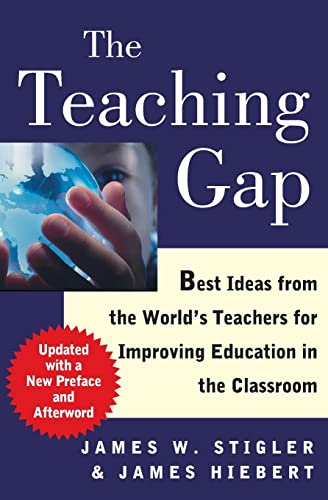
The Teaching Gap: Best Ideas from the World's Teachers for Improving Education in the Classroom
📄 Viewing lite version
Full site ›
10.44
USD
🛒 Buy New on Amazon 🇺🇸
Book Details
Author(s)James W. Stigler,
PublisherFree Press
ISBN / ASIN1439143137
ISBN-139781439143131
Sales Rank25,539
CategoryEducation
MarketplaceUnited States 🇺🇸
Description ▲
In a time when educators and politicians in the United States are fumbling for a fix--from vouchers to smaller class sizes--for ailing public schools, it's refreshing to read the more sophisticated take on what can be done to improve American education found in The Teaching Gap, a straightforward analysis of approaches towards teaching around the world. James W. Stigler, a UCLA psychology professor, and James Hiebert, an education professor at the University of Delaware, argue that America's culture of teaching needs to be changed before we see any real change in student achievement--and they're not simply talking about higher pay and more respect.
Similar Products ▼
- Five Practices for Orchestrating Productive Mathematical Discussion
- What's Math Got to Do with It?: How Teachers and Parents Can Transform Mathematics Learning and Inspire Success
- Yet Another Introduction to Analysis
- Learning Gap: Why Our Schools Are Failing and What We Can Learn from Japanese and Chinese Education
- Mathematical Mindsets: Unleashing Students' Potential through Creative Math, Inspiring Messages and Innovative Teaching
- Teaching Science for Understanding in Elementary and Middle Schools
- 5 Practices for Orchestrating Productive Mathematics Discussions [NCTM]
- Learning to Improve: How America’s Schools Can Get Better at Getting Better
- Elementary and Middle School Mathematics: Teaching Developmentally (10th Edition)
- Lesson Study: A Japanese Approach To Improving Mathematics Teaching and Learning (Studies in Mathematical Thinking and Learning Series)
More Books in Education
Conceptual Physics & Prs $20 Rebate Card Pk
View
Routledge Library Editions: Education Mini-Set H Histo…
View
Emotional and Behavioural Difficulties (Special Educat…
View
Linear Equations, Inequalities, & Functions
View
Unfulfilled Expectations: Home and School Influences o…
View
Study Guide for Foundations of Economics plus MyEconLa…
View
Question Answer Relationships: A Simple Taxonomy of Qu…
View
Routledge Library Editions: Education Mini-Set A: Comp…
View
Routledge Library Editions: Education Mini-Set A: Comp…
View