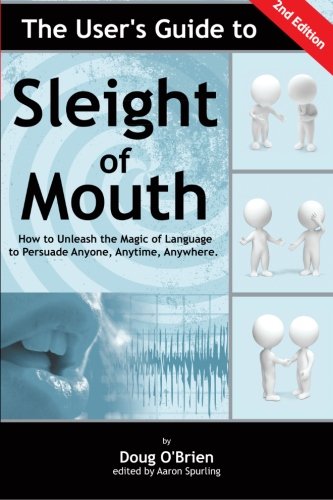
The User's Guide to Sleight of Mouth: How to Unleash the Magic of Language to Persuade Anyone, Anytime, Anywhere
📄 Viewing lite version
Full site ›
Book Details
Author(s)O'Brien, Doug
ISBN / ASIN1463511035
ISBN-139781463511036
AvailabilityIn Stock.
Sales Rank291,173
CategoryPsychology
MarketplaceUnited States 🇺🇸
Description ▲
What is Sleight of Mouth? Sleight of Mouth is a persuasion skill, a vehicle for conversationally changing beliefs. It is a system of 14 different patterns of response to a stated belief. A system that, once mastered, can allow you to always have a response that will effectively elucidate your position and help you to persuade rather than be persuaded. Simply put, it will help you win any argument, be verbally powerful and powerfully verbal. Where Did Sleight of Mouth Come From? Sleight of Mouth is a result of the methodology of NLP (Nuero Linguistic Programming) being applied to NLP itself, or, more properly, to Richard Bandler's debate skills. NLP grew out of Richard Bandler and John Grinder analyzing and codifying the methods of a number of the 20th Century's great therapists like Milton Erickson, Virginia Satir and others. Robert Dilts, one of Bandler and Grinder's early students, applied this same methodology to Bandler's own unique way with people. In his NLP Certification courses, Bandler would challenge participants to use their newly acquired skills to persuade him that a belief system adopted for the occasion (eg."I can't see the curve, therefore the world is flat.") was wrong. As hard as they tried, Bandler was always able to field an army of responses to turn their "logical" arguments around. Dilts was able to discern the patterns of persuasion that Bandler used. Dilts systemized the patterns into specific categories and developed an elegant flow chart of them which makes it wonderfully easy and fun to use. "The User's Guide to Sleight of Mouth" by Doug O'Brien teaches you this system in a wonderfully succinct and user-friendly manner that will have you using it in no time. Here's just some of what you'll learn: * The inner structure of Beliefs. It's true - every belief has the same inner structure and - once you know that - you can unlock and unpack any belief that comes your way * The Agreement Frame - it's like verbal Aikido. * The Precision Model - a powerful, yet simple, technique to bust through any fluffy language you hear people using and get them to be more specific and accurate * The Polya Patterns of Plausible Inference * Fourteen different "Sleight of Mouth" patterns for reframing those beliefs * Much much More
More Books in Psychology
Cognitive Neuropsychology: A Clinical Introduction
View
Kassin Social Psychology Seventh Edition Plus Lahiri T…
View
Attention Deficit Hyperactivity Disorder (adhd) Resear…
View
Enhancing Sexuality: A Problem-Solving Approach Client…
View
The Psychology Research Handbook: A Guide for Graduate…
View
Carl Jung and Soul Psychology
View
Anthropology and Psychoanalysis: An Encounter Through …
View
Invisible Acts of Power: Channeling Grace in Your Ever…
View
From Ancient Myth to Modern Healing: Themis: Goddess o…
View