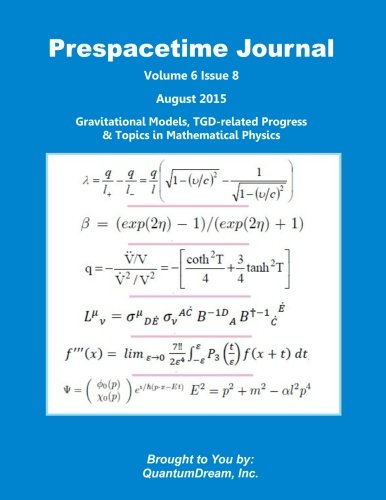
Prespacetime Journal Volume 6 Issue 8: Gravitational Models, TGD-related Progress & Topics in Mathematical Physics
📄 Viewing lite version
Full site ›
⌛ 🇮🇳 India pricing being fetched…
Prices will appear once fetched — usually within a few minutes.
View in:
🇺🇸 USA
Book Details
Author(s)Quantum Dream Inc.
ISBN / ASIN1516921925
ISBN-139781516921928
MarketplaceIndia 🇮🇳
Description ▲
Prespacetime Journal ("PSTJ," http://www.prespacetime.com) is a publication in which physicists, mathematicians and other learned scholars publish their research results and express their views on the origin, nature and mechanism of spacetime and its possible connection to a prespacetime. It is also a journal where all learned scholars can present their models and experimental results on elemental particles, fundamental forces including gravity and related topics. This is PSTJ Volume 6 Issue 8 first published in August 2015. It is entitled "Gravitational Models, TGD-related Progress & Topics in Mathematical Physics" and contains following articles: (1) The Solution of Motion of a Test Particle in the Gravitational Field of a Rotating Source; (2) Discretization & Quantum Group Description as Different Aspects of Finite Measurement Resolution; (3) Does the Rate of Cosmic Expansion Oscillate? (4) Does the Physics of SmB6 Make the Fundamental Dynamics of TGD Directly Visible? (5) On Beta Stability Line and Binding Energy; (6) Bianchi Type VIII Inflationary Universe with Massless Scalar Field in General Relativity; (7) Newman-Penrose Equations, Bianchi identities & Weyl-Lanczos Relations; (8) Spin Coefficients Formalism; (9) Bianchi Type-III Bulk Viscous String Cosmological Model in Self-Creation Theory of Gravitation; (10) Cosmological Models Filled with Perfect Fluid & Dark Energy in f(R,T) Theory of Gravity; (11) A Summation due to Ramanujan and Its Generalization; (12) On the Legendre Polynomials; (13) A Possible Route to Navier-Stokes Cosmology on Cantor Sets: and (14) On Some Expected Novel Results from the LHC.