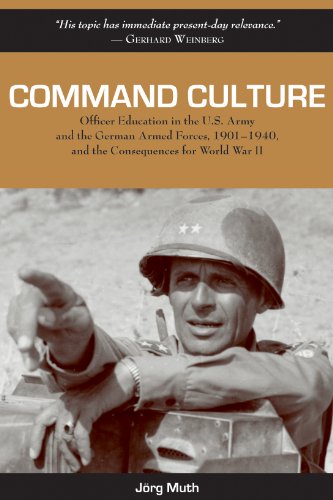
Command Culture: Officer Education in the U.S. Army and the German Armed Forces, 1901-1940, and the Consequences for World War II
📄 Viewing lite version
Full site ›
Book Details
Author(s)Jörg Muth
PublisherUniversity of North Texas Press
ISBN / ASIN1574413031
ISBN-139781574413038
Sales Rank1,600,740
CategoryHistory
MarketplaceUnited States 🇺🇸
Description ▲
- Selected by the US Army Chief of Staff, General Raymond T. Odierno, for his professional reading list, March 2012.
- Selected by the Commandant of the US Marine Corps, General James F. Amos, for his professional reading list, January 2013.
COMMAND CULTURE is now required reading for senior enlisted men and intermediate officer ranks of the US Marine Corps.
- Received the 'Distinguished Writing Award' of the Army Historical Foundation in the category 'Institutional/Functional History', June 2012.
In Command Culture, Jörg Muth examines the different paths the United States Army and the German Armed Forces traveled to select, educate, and promote their officers in the crucial time before World War II. Muth demonstrates that the military education system in Germany represented an organized effort where each school and examination provided the stepping stone for the next. But in the United States, there existed no communication about teaching contents or didactical matters among the various schools and academies, and they existed in a self chosen insular environment. American officers who finally made their way through an erratic selection process and past West Point to the important Command and General Staff School at Fort Leavenworth, Kansas, found themselves usually deeply disappointed, because they were faced again with a rather below average faculty who forced them after every exercise to accept the approved "school solution."
Command Culture explores the paradox that in Germany officers came from a closed authoritarian society but received an extremely open minded military education, whereas their counterparts in the United States came from one of the most democratic societies but received an outdated military education that harnessed their minds and limited their initiative. On the other hand, German officer candidates learned that in war everything is possible and a war of extermination acceptable. For American officers, raised in a democracy, certain boundaries could never be crossed.
This work for the first time clearly explains the lack of audacity of many high ranking American officers during World War II, as well as the reason why so many German officers became perpetrators or accomplices of war crimes and atrocities or remained bystanders without speaking up. Those American officers who became outstanding leaders in World War II did so not so much because of their military education, but despite it.The book connects successfully the pre-World
War II officer education of the U. S. Army and its traditions and culture with the conduct of the War against Terror today.
More Books in History
The Search for the Perfect Language
View
Twilight and History (Wiley Pop Culture and History Se…
View
Mexican American Voices: A Documentary Reader (Uncover…
View
For the Thrill of It: Leopold, Loeb, and the Murder Th…
View
The Code Book: The Science of Secrecy from Ancient Egy…
View
The Sunflower: On the Possibilities and Limits of Forg…
View
The Jacksonian Era (The American History Series)
View
Louisiana: A History
View
War in Ancient Egypt: The New Kingdom (Ancient World a…
View
The 1960s: A Documentary Reader
View
A History of Russia, Central Asia and Mongolia, Volume…
View