Today, flavor chemists can generate copious amounts of data in a short time with relatively little effort using automated solid phase micro-extraction, Gerstel-Twister® and other extraction techniques in combination with gas chromatographic (GC) analysis. However, more data does not necessarily mean better understanding. In fact, the ability to extract, isolate, and concentrate potential flavor-important chemicals from complex food systems has surpassed the ability to understand how the chemical data relates to flavor.
Sensory-Directed Flavor Analysis helps chemists unlock the flavor secrets that may be hiding in their chromatograms by translating cold hard numbers into a better understanding of the sense of smell and taste. The author integrates the two disciplines of sensory science and analytical chemistry, encouraging sensory scientists to incorporate more analytical data while encouraging analytical chemists to include more sensory techniques. Using more ancillary techniques helps each discipline elucidate how various chemical constituents influence food flavor and appeal. The book discusses important enabling technologies and analytical methods including GC-olfactometry (GC-O), combination GC-O and multi-dimensional GC, the application of odor activity values (OAVs), and recombination studies, as well as solid-phase dynamic extraction and preseparation techniques. A broad array of applications, in addition to dozens of tables, graphs, gas chromatograms, and pictures, are included throughout the book.
Highlighting the advantages and disadvantages and the appropriate circumstances for each method of analysis, Sensory-Directed Flavor Analysis offers flavor scientists an essential reference to deepen their understanding of the function of chemicals on the perception of taste.
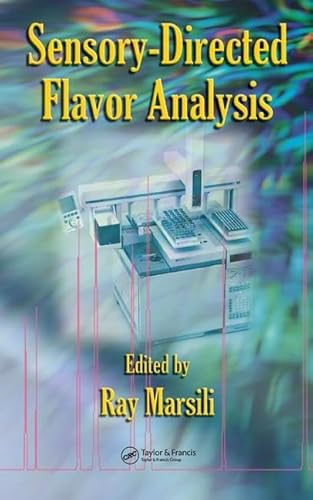
Sensory-Directed Flavor Analysis (Food Science and Technology)
📄 Viewing lite version
Full site ›
Book Details
PublisherCRC Press
ISBN / ASIN1574445685
ISBN-139781574445688
AvailabilityUsually ships in 24 hours
Sales Rank3,211,989
CategoryTechnology & Engineering
MarketplaceUnited States 🇺🇸
Description ▲
More Books in Technology & Engineering
Fourth Dimension in Building: Strategies for Avoiding …
View
Design and Evaluation of Rigid and Flexible Pavements,…
View
Nuclear Nonproliferation: Status Of U.s. Efforts To Im…
View
Time-Domain Numerical Methods for Modelling Antennas, …
View
The Rise of the Standard Model: A History of Particle …
View
Synthesis, Properties and Crystal Chemistry of Perovsk…
View
Error Propagation in Environmental Modelling with GIS …
View
Crops And Environmental Change: An Introduction To Eff…
View
Multicarrier Modulation with Low PAR: Applications to …
View