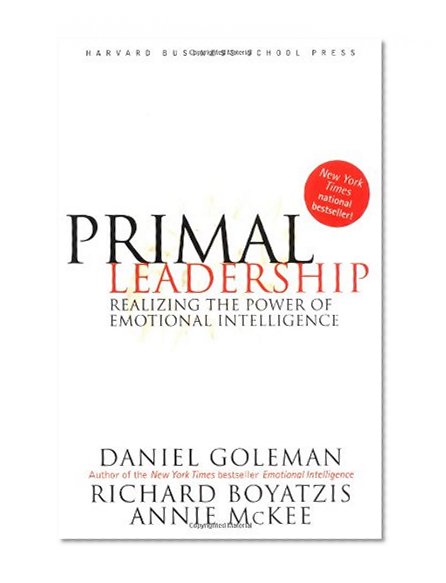
Primal Leadership: Realizing the Power of Emotional Intelligence
📄 Viewing lite version
Full site ›
Book Details
PublisherHarvard Business Review Press
ISBN / ASIN157851486X
ISBN-139781578514861
AvailabilityUsually ships in 24 hours
Sales Rank153,229
CategoryPsychology
MarketplaceUnited States 🇺🇸
Description ▲
Business leaders who maintain that emotions are best kept out of the work environment do so at their organization's peril. Bestselling author Daniel Goleman's theories on emotional intelligence (EI) have radically altered common understanding of what "being smart" entails, and in Primal Leadership, he and his coauthors present the case for cultivating emotionally intelligent leaders. Since the actions of the leader apparently account for up to 70 percent of employees' perception of the climate of their organization, Goleman and his team emphasize the importance of developing what they term "resonant leadership." Focusing on the four domains of emotional intelligence--self-awareness, self-management, social awareness, and relationship management--they explore what contributes to and detracts from resonant leadership, and how the development of these four EI competencies spawns different leadership styles. The best leaders maintain a style repertoire, switching easily between "visionary," "coaching," "affiliative," and "democratic," and making rare use of less effective "pace-setting" and "commanding" styles. The authors' discussion of these methods is informed by research on the workplace climates engendered by the leadership styles of more than 3,870 executives. Indeed, the experiences of leaders in a wide range of work environments lend real-life examples to much of the advice Goleman et al. offer, from developing the motivation to change and creating an improvement plan based on learning rather than performance outcomes, to experimenting with new behaviors and nurturing supportive relationships that encourage change and growth. The book's final section takes the personal process of developing resonant leadership and applies it to the entire organizational culture. --S. Ketchum
More Books in Psychology
Cognitive Neuropsychology: A Clinical Introduction
View
Kassin Social Psychology Seventh Edition Plus Lahiri T…
View
Attention Deficit Hyperactivity Disorder (adhd) Resear…
View
Enhancing Sexuality: A Problem-Solving Approach Client…
View
The Psychology Research Handbook: A Guide for Graduate…
View
Carl Jung and Soul Psychology
View
Anthropology and Psychoanalysis: An Encounter Through …
View
Invisible Acts of Power: Channeling Grace in Your Ever…
View
From Ancient Myth to Modern Healing: Themis: Goddess o…
View