What if you could combine the agility, adaptability, and cohesion of a small team with the power and resources of a giant organization?
THE OLD RULES NO LONGER APPLY . . .
When General Stanley McChrystal took command of the Joint Special Operations Task Force in 2004, he quickly realized that conventional military tactics were failing. Al Qaeda in Iraq was a decentralized network that could move quickly, strike ruthlessly, then seemingly vanish into the local population. The allied forces had a huge advantage in numbers, equipment, and training—but none of that seemed to matter.
TEACHING A LEVIATHAN TO IMPROVISE
It’s no secret that in any field, small teams have many advantages—they can respond quickly, communicate freely, and make decisions without layers of bureaucracy. But organizations taking on really big challenges can’t fit in a garage. They need management practices that can scale to thousands of people.
General McChrystal led a hierarchical, highly disciplined machine of thousands of men and women. But to defeat Al Qaeda in Iraq, his Task Force would have to acquire the enemy’s speed and flexibility. Was there a way to combine the power of the world’s mightiest military with the agility of the world’s most fearsome terrorist network? If so, could the same principles apply in civilian organizations?
A NEW APPROACH FOR A NEW WORLD
McChrystal and his colleagues discarded a century of conventional wisdom and remade the Task Force, in the midst of a grueling war, into something new: a network that combined extremely transparent communication with decentralized decision-making authority. The walls between silos were torn down. Leaders looked at the best practices of the smallest units and found ways to extend them to thousands of people on three continents, using technology to establish a oneness that would have been impossible even a decade earlier. The Task Force became a “team of teams”—faster, flatter, more flexible—and beat back Al Qaeda.
BEYOND THE BATTLEFIELD
In this powerful book, McChrystal and his colleagues show how the challenges they faced in Iraq can be relevant to countless businesses, nonprofits, and other organizations. The world is changing faster than ever, and the smartest response for those in charge is to give small groups the freedom to experiment while driving everyone to share what they learn across the entire organization. As the authors argue through compelling examples, the team of teams strategy has worked everywhere from hospital emergency rooms to NASA. It has the potential to transform organizations large and small.
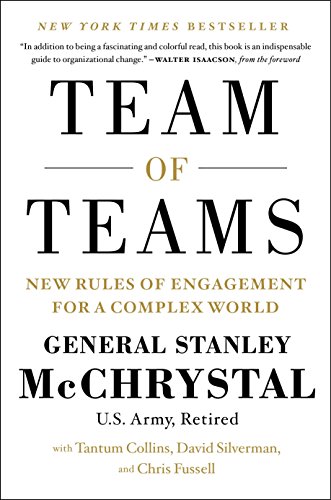
Team of Teams: New Rules of Engagement for a Complex World
📄 Viewing lite version
Full site ›
Book Details
Author(s)McChrystal, Stanley Gen.
PublisherPortfolio
ISBN / ASIN1591847486
ISBN-139781591847489
AvailabilityIn Stock.
Sales Rank2,066
CategoryBusiness & Economics
MarketplaceUnited States 🇺🇸
Description ▲
Similar Products ▼
- Leaders: Myth and Reality
- One Mission: How Leaders Build a Team of Teams
- My Share of the Task: A Memoir
- My Share of the Task: A Memoir
- Appreciative Inquiry: A Positive Revolution in Change
- Leadership BS: Fixing Workplaces and Careers One Truth at a Time
- Turn the Ship Around!: A True Story of Turning Followers into Leaders
- Annual Editions: Human Resources
- Human Resources Kit For Dummies
- Extreme Ownership: How U.S. Navy SEALs Lead and Win (New Edition)
More Books in Business & Economics
Business Cycles and Forecasting
View
Development Economics: Its Position in the Present Sta…
View
Cost Systems Design
View
So You Want to Dance on Broadway
View
The Blueprint: Reviving Innovation, Rediscovering Risk…
View
Managing IT Outsourcing, Second Edition
View
Education and the Creation of Capital in the Early Ame…
View
Global Corruption Report 2005: Special Focus: Corrupti…
View
More Tales for Trainers: Using Stories and Metaphors t…
View
Advertising, Society and Consumer Culture
View