The acclaimed labor lawyer and prizewinning author Thomas Geoghegan asks: where are we better off America or Europe? In an idiosyncratic, entertaining travelogue that plays on public policy, Geoghegan asks what our lives would be like if we lived them as Europeans. Sneaking out of his workaholic American life, he takes five trips where he tries to understand so-called European socialism firsthand. Though he first tries France (which has become a rhetorical stand-in for the continent as a whole in many Americans' minds), he eventually ventures into Germany to see what some call the "boring" Europe. There he finds the true "other" an economic model with more bottom-up worker control than that of any other country in the world and argues that, while we have to take Germany s problems seriously, we also have to look seriously at how much it has achieved. Social democracy may let us live nicer lives; it also may be the only way to be globally competitive. This wry, timely book helps us understand why the European model, contrary to popular neoliberal wisdom, may thrive well into the twenty-first century without compromising its citizens' ease of living and be the best example for the United States to follow.
Germany is more generous than the U.S.:
The average number of paid vacation days in the U.S. is 13, versus Germany s 35
New mothers in the U.S. get three months of unpaid job-protected leave and only if they work for a company of 50 or more employees, while Germany mandates four months paid leave and will pay parents 67% of their salary to stay home for up to 14 months to care for a newborn.
U.S. life expectancy is 50th in the world, compared to Germany s 32nd.
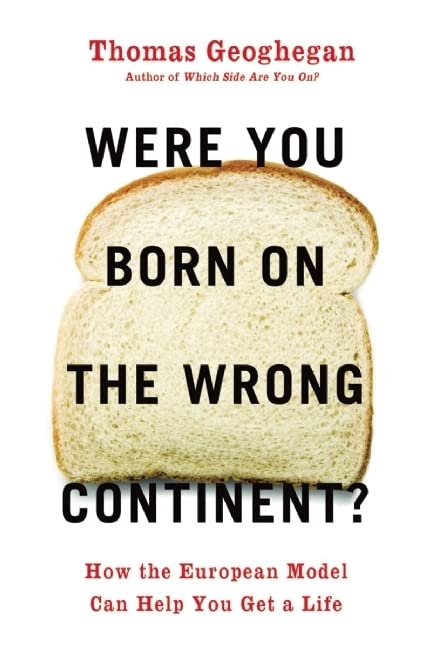
Were You Born on the Wrong Continent?: How the European Model Can Help You Get a Life
📄 Viewing lite version
Full site ›
9
USD
🛒 Buy New on Amazon 🇺🇸
Book Details
Author(s)Thomas Geoghegan,
PublisherThe New Press
ISBN / ASIN159558403X
ISBN-139781595584038
Sales Rank174,578
CategoryPolitical Science
MarketplaceUnited States 🇺🇸
Description ▲
More Books in Political Science
The Millennium Development Goals and Beyond: Internati…
View
Transnational Networks in Regional Integration: Govern…
View
Forensic Psychophysiology Using the Polygraph: Scienti…
View
Gender, Islam and Democracy in Indonesia (ASAA Women i…
View
E-Governance: A Change Management Tool
View
Shop Floor Bargaining and the State: Historical and Co…
View
Red State Uprising: How to Take Back America
View
A Community Health Approach to the Assessment of Infan…
View
Foreign Aid and Landmine Clearance: Governance, Politi…
View