Increasingly, cracks are appearing in the capacity of communities, ecosystems, and landscapes to provide the goods and services that sustain our planet's well-being. The response from most quarters has been for "more of the same" that created the situation in the first place: more control, more intensification, and greater efficiency.
"Resilience thinking" offers a different way of understanding the world and a new approach to managing resources. It embraces human and natural systems as complex entities continually adapting through cycles of change, and seeks to understand the qualities of a system that must be maintained or enhanced in order to achieve sustainability. It explains why greater efficiency by itself cannot solve resource problems and offers a constructive alternative that opens up options rather than closing them down.
In Resilience Thinking, scientist Brian Walker and science writer David Salt present an accessible introduction to the emerging paradigm of resilience. The book arose out of appeals from colleagues in science and industry for a plainly written account of what resilience is all about and how a resilience approach differs from current practices. Rather than complicated theory, the book offers a conceptual overview along with five case studies of resilience thinking in the real world. It is an engaging and important work for anyone interested in managing risk in a complex world. Increasingly, cracks are appearing in the capacity of communities, ecosystems, and landscapes to provide the goods and services that sustain our planet's well-being. The response from most quarters has been for "more of the same" that created the situation in the first place: more control, more intensification, and greater efficiency.
"Resilience thinking" offers a different way of understanding the world and a new approach to managing resources. It embraces human and natural systems as complex entities continually adapting through cycles of change, and seeks to understand the qualities of a system that must be maintained or enhanced in order to achieve sustainability. It explains why greater efficiency by itself cannot solve resource problems and offers a constructive alternative that opens up options rather than closing them down.
In Resilience Thinking, scientist Brian Walker and science writer David Salt present an accessible introduction to the emerging paradigm of resilience. The book arose out of appeals from colleagues in science and industry for a plainly written account of what resilience is all about and how a resilience approach differs from current practices. Rather than complicated theory, the book offers a conceptual overview along with five case studies of resilience thinking in the real world. It is an engaging and important work for anyone interested in managing risk in a complex world.
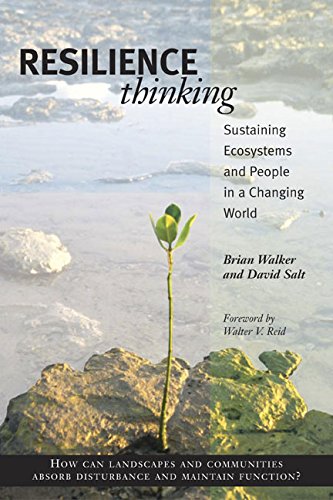
Resilience Thinking: Sustaining Ecosystems and People in a Changing World
📄 Viewing lite version
Full site ›
Book Details
Author(s)Brian Walker PhD, David Salt
PublisherIsland Press
ISBN / ASIN1597260932
ISBN-139781597260930
AvailabilityUsually ships in 24 hours
Sales Rank308,603
MarketplaceUnited States 🇺🇸
Description ▲
Similar Products ▼
- Complexity: A Guided Tour
- Thinking in Systems: A Primer
- Resilience Practice: Building Capacity to Absorb Disturbance and Maintain Function
- Global Catastrophic Risks
- Pursuing Sustainability: A Guide to the Science and Practice
- Panarchy: Understanding Transformations in Human and Natural Systems
- Panarchy Synopsis: Understanding Transformations in Human and Natural Systems
- Systems Thinking For Social Change: A Practical Guide to Solving Complex Problems, Avoiding Unintended Consequences, and Achieving Lasting Results
- Changes in the Land: Indians, Colonists, and the Ecology of New England
- You Majored in What?: Designing Your Path from College to Career