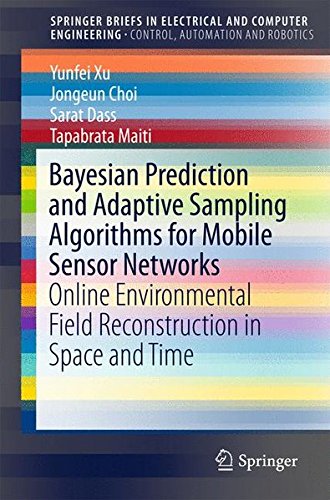
Bayesian Prediction and Adaptive Sampling Algorithms for Mobile Sensor Networks: Online Environmental Field Reconstruction in Space and Time (SpringerBriefs in Electrical and Computer Engineering)
📄 Viewing lite version
Full site ›
⌛ 🇫🇷 France pricing being fetched…
Prices will appear once fetched — usually within a few minutes.
View in:
🇺🇸 USA
Book Details
PublisherSpringer
ISBN / ASIN3319219200
ISBN-139783319219202
CategoryTechnology & Engineering
MarketplaceFrance 🇫🇷
Description ▲
This brief introduces a class of problems and models for the prediction of the scalar field of interest from noisy observations collected by mobile sensor networks. It also introduces the problem of optimal coordination of robotic sensors to maximize the prediction quality subject to communication and mobility constraints either in a centralized or distributed manner. To solve such problems, fully Bayesian approaches are adopted, allowing various sources of uncertainties to be integrated into an inferential framework effectively capturing all aspects of variability involved. The fully Bayesian approach also allows the most appropriate values for additional model parameters to be selected automatically by data, and the optimal inference and prediction for the underlying scalar field to be achieved. In particular, spatio-temporal Gaussian process regression is formulated for robotic sensors to fuse multifactorial effects of observations, measurement noise, and prior distributions for obtaining the predictive distribution of a scalar environmental field of interest. New techniques are introduced to avoid computationally prohibitive Markov chain Monte Carlo methods for resource-constrained mobile sensors. Bayesian Prediction and Adaptive Sampling Algorithms for Mobile Sensor Networks starts with a simple spatio-temporal model and increases the level of model flexibility and uncertainty step by step, simultaneously solving increasingly complicated problems and coping with increasing complexity, until it ends with fully Bayesian approaches that take into account a broad spectrum of uncertainties in observations, model parameters, and constraints in mobile sensor networks. The book is timely, being very useful for many researchers in control, robotics, computer science and statistics trying to tackle a variety of tasks such as environmental monitoring and adaptive sampling, surveillance, exploration, and plume tracking which are of increasing currency. Problems are solved creatively by seamless combination of theories and concepts from Bayesian statistics, mobile sensor networks, optimal experiment design, and distributed computation.
More Books in Technology & Engineering
Fourth Dimension in Building: Strategies for Avoiding …
View
Design and Evaluation of Rigid and Flexible Pavements,…
View
Nuclear Nonproliferation: Status Of U.s. Efforts To Im…
View
Time-Domain Numerical Methods for Modelling Antennas, …
View
The Rise of the Standard Model: A History of Particle …
View
Synthesis, Properties and Crystal Chemistry of Perovsk…
View
Error Propagation in Environmental Modelling with GIS …
View
Crops And Environmental Change: An Introduction To Eff…
View
Multicarrier Modulation with Low PAR: Applications to …
View
International Conference on Advanced Phase Measurement…
View