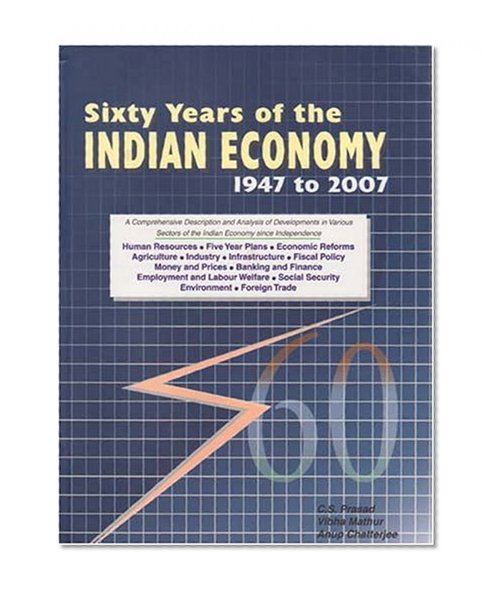
Sixty Years of the Indian Economy - 1947 to 2007: (two-volume set)
📄 Viewing lite version
Full site ›
Book Details
PublisherNew Century Publications
ISBN / ASIN8177081322
ISBN-139788177081329
AvailabilityUsually ships in 12 to 13 days
Sales Rank12,107,966
CategoryBusiness & Economics
MarketplaceUnited States 🇺🇸
Description ▲
At the time of independence in 1947, India was a typically backward economy. Owing to poor technological and scientific capabilities, industrialization was limited and lop-sided. The agricultural sector exhibited features of feudal and semi-feudal institutions, resulting into low productivity. Means of transport and communications were underdeveloped, educational and health facilities were inadequate, and social security measures were virtually non-existent. Poverty was rampant and unemployment widespread, both making for a low general standard of living. These were the socio-economic settings under which the founding fathers had to chart a program of nation-building. In their collective wisdom, they adopted the middle course of a mixed economy, assigning a pivotal role to both the public sector and economic planning. This new approach to economic and social development was set within a framework of parliamentary democracy guaranteeing universal franchise. After 60 years of development efforts, India is presently one of world's fastest growing economies. In the last few years, it has emerged as a global economic power, being the leading outsourcing destination and a favorite of international investors. Sixty Years of the Indian Economy provides a comprehensive description and analysis of developments in various sectors of the Indian economy since its independence. The book particularly focuses on the reform measures undertaken since 1991. The areas covered include human resources, five year plans, economic reforms, agriculture, industry, infrastructure, fiscal policy, money and prices, banking and finance, employment and labor welfare, social security, environment, and foreign trade. This work puts into perspective emerging lessons for the future.
More Books in Business & Economics
Towers of gold, feet of clay: The Canadian banks
View
The Twelve Organizational Capabilities
View
The Looting Machine: Warlords, Tycoons, Smugglers and …
View
The Real-Life MBA: The No-Nonsense Guide to Winning th…
View
Collins Cape Revision Guide - Management of Business (…
View
Glencoe Mathematics for Business and Personal Finance,…
View
Economics: Ap Edition (A/P Economics)
View
Money, Banking and Financial Markets
View
Money, Banking, and Financial Markets
View