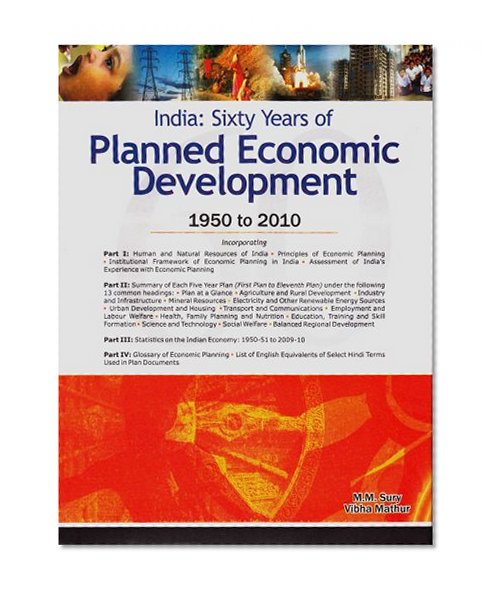
India: Sixty Years of Planned Economic Development: 1950 to 2010
📄 Viewing lite version
Full site ›
Book Details
Author(s)M.M. Sury, Vibha Mathur
PublisherNew Century Publications
ISBN / ASIN8177082450
ISBN-139788177082456
AvailabilityUsually ships in 1 to 2 months
Sales Rank3,204,569
CategoryBusiness & Economics
MarketplaceUnited States 🇺🇸
Description ▲
The resource base of a country consists of human resources, non-renewable resources, and renewable resources. Economic planning is concerned with the effective and optimal utilization of the potential resources of an economy. This is particularly so in the context of underdeveloped countries which are striving to raise the standard of living of the masses. In fact, planning is a process aiming not merely at the best utilization of material resources but also at the development of human faculties and institutional framework suitable to the needs and aspirations of the people. In India, the establishment of the Planning Commission in 1950 heralded a new era in the economic history. It makes an assessment of the material, capital, and human resources of the country, and it investigates the possibilities of augmenting these resources as are found to be deficient in relation to India's requirements. It, then, formulates a plan for the most effective and balanced utilization of the country's resources. Part I of this book examines the human and natural resources of India, the principles of economic planning, the institutional framework of economic planning in India, and the assessment of India's experience with economic planning. Part II provides a summary of each of India's Five Year Plans under the following 13 common theme headings: plan at a glance * agriculture and rural development * industry and infrastructure * mineral resources * electricity and other renewable energy sources * urban development and housing * transport and communications * employment and labor welfare * health, family planning, and nutrition * education, training, and skill formation * science and technology * social welfare * balanced regional development. Part III contains sector-wise, time-series statistics on the Indian economy from 1950 to 2010. Part IV of the book comprises glossary of economic planning and a list of English equivalents of select Hindi terms used in Plan Documents.
More Books in Business & Economics
Business Cycles and Forecasting
View
Development Economics: Its Position in the Present Sta…
View
Cost Systems Design
View
So You Want to Dance on Broadway
View
The Blueprint: Reviving Innovation, Rediscovering Risk…
View
Managing IT Outsourcing, Second Edition
View
Education and the Creation of Capital in the Early Ame…
View
Global Corruption Report 2005: Special Focus: Corrupti…
View
More Tales for Trainers: Using Stories and Metaphors t…
View