The competitiveness this situation produces thwarts patterns of permanent hierarchical relations. Through a discourse-centered 'anthropology of the everyday' approach, gender relations among the Shuar is thus characterized as a case of 'competitive complementarity". Perruchon argues that Shuar gender relations aer too complex to be placed within either of the categories "complementary" or "asymmetrical" and claims that there exists a contextually dependent difference in gender influence, as well as in gendered discourses about gender according to degree of (in)formality. Though a history of change Shuar Shamanism is in the process of being utterly gendered. Even if people still regard shamanism as non-gendered, it can be observed in the recent practices that women have another and less prestigious, role than men, limited to the role of being assistants to male shamans. This change is severely altering the 'traditional' status position of female shamans, as well as being a sign of the process of female subordination that is going on in Shuar society.
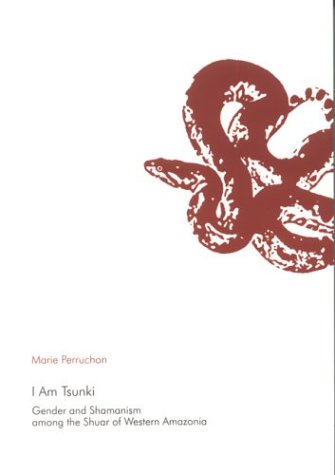
I Am Tsunki: Gender & Shamanism Among the Shuar of Western Amazonia (Uppsala Studies in Cultural Anthropology, 33)
📄 Viewing lite version
Full site ›
Book Details
Author(s)Marie Perruchon
PublisherCoronet Books Inc.
ISBN / ASIN9155456464
ISBN-139789155456467
AvailabilityUsually ships in 24 hours
Sales Rank5,901,664
MarketplaceUnited States 🇺🇸
Description ▲
In this Ph.D. thesis, the author brings together what is generally treated as two distinct domains of analysis: gender and shamanism. She investigates the relationship between gender and achievement of power through the shaman's role in Shuar society. Shamanic knowledge is a social value through which relations of gender and power are culturally articulated, and Shuar culture articulates a general competitive egalitarianism. The single most important factor for creating this circumstance is the fact that people of all ages and both genders take ayahuasca - a decoction of psychotropic plants. This makes spiritual knowledge quite evenly distributed among the population. Every individual has personal experience of spiritual contact, and what divides non-shamans and shamans is the ability to cure/afflict. Every individual is therefore more or less 'shamanizing', and women are not excluded from spiritual knowledge or practice.