VERDI: Falstaff (complete opera) Newly translated libretto, program notes, and synopsis. Link to audio tracks.
Mariano Stabile, Renata Tebaldi, Cesare Valletti, et al.: vocal soloists
La Scala Orchestra & Chorus
Victor de Sabata: conductor
Verdi’s last opera, written when he was approaching eighty, was only the second comedy of his long career, following the ill-fated Un giorno di regno of fifty years before. His friend and collaborator Arrigo Boito, who had with some difficulty talked him into composing Otello several years earlier, now had an easier time convincing him to crown his glory with one more tribute to his beloved Shakespeare. The three principals are all famous portrayers of their roles, aided by an outstanding supporting cast. Mariano Stabile was a veteran Italian basso buffo who had the role of Falstaff in his belly, if not his bones. Renata Tebaldi was the most famous Italian lyric soprano of her era and she remains, along with Maria Callas, the most loved soprano of recent years. Cesare Valletti was a tenore di grazia, a tenor with a light, flexible head voice of exquisite beauty. Live performance, Milan, May 26, 1951.
Ilustration © Rafal Olbinski,
Courtesy of Patinae Inc.
“One of the most remarkable performances of anything by Verdi ever captured on a disc. Mariano Stabile’s Falstaff was a legendary achievement, dramatically and vocally, and this recording is worth every penny just for his authentic, genuinely buffo take on the role. Paolo Silveri is excellent as Ford, and the youthful Renata Tebaldi makes a glorious noise as his wife. But these undoubted stars are eclipsed by de Sabata, who creates a performance of electric immediacy with an extraordinary attention to the score’s detail and architecture.†— Rough Guide to Opera
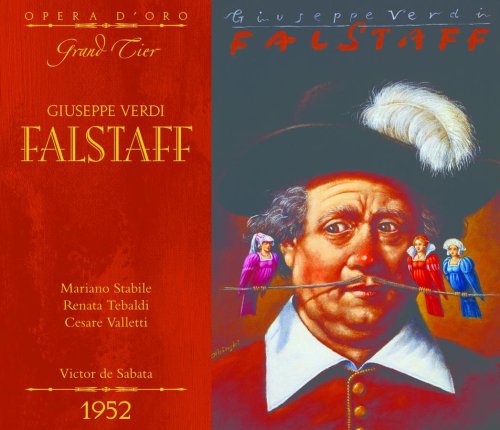
OPD 7041 Verdi-Falstaff: Italian-English Libretto (Opera d'Oro Grand Tier)
📄 Viewing lite version
Full site ›
⌛ 🇩🇪 Germany pricing being fetched…
Prices will appear once fetched — usually within a few minutes.
View in:
🇺🇸 USA
Book Details
Author(s)Guiseppe Verdi
PublisherOpera d'Oro
ISBN / ASINB0027CSKC4
ISBN-13978B0027CSKC9
MarketplaceGermany 🇩🇪